

Dubai has rapidly evolved into a global startup hub, attracting entrepreneurs across fintech, logistics, e-commerce, and AI. With strong infrastructure, investor support, and a digital-first economy, launching a startup here is full of opportunity, but also critical decisions.
One of the earliest and most impactful choices founders face in startup product development in Dubai is selecting the right software approach.
Should you build a custom solution tailored to your vision, or rely on ready-made tools to move faster?
This decision directly affects your speed, scalability, costs, and long-term growth. Understanding both options will help you make a smarter, future-ready choice. Let’s start from the basics.
What is Custom Software and Off-the-Shelf Software?
Before diving into comparisons, it’s important to understand what each approach means clearly. Many early-stage founders make decisions based on cost or speed alone, without fully grasping how these options impact long-term growth and flexibility.
- Custom Software Development
Software built specifically for your business needs, workflows, and goals. It is designed from scratch to match your product vision. - Off-the-Shelf Software Solutions
Pre-built tools designed for general use across industries. These are ready to use and require minimal setup.
Off-the-shelf means renting a ready-made space. Custom software refers to building something uniquely yours. Both serve a purpose, but at different stages of your startup journey.
Key Differences Between Custom Software and Off-the-Shelf Solutions
To make a confident decision, it helps to look at both approaches side by side. While both options can support your operations, they differ significantly in terms of flexibility, scalability, cost structure, and long-term value.
| Factor | Custom Software | Off-the-Shelf Software |
| Customization | Fully tailored to your needs | Limited flexibility |
| Cost | Higher upfront investment | Lower initial cost |
| Time to Launch | Longer development time | Immediate deployment |
| Scalability | Highly scalable | Often limited |
| Ownership | Full control | Subscription-based |
| Integration | Seamless integration | Can be restrictive |
| Competitive Advantage | Strong differentiation | Common tools |
Custom Software: Benefits for Startups
For startups looking to build a strong and scalable foundation, custom software offers significant advantages. It allows you to align technology directly with your business goals rather than adjusting your processes to fit existing tools.
- Built Around Your Idea
Perfect for startups with unique business models or innovative solutions. - Scalable from Day One
Designed to grow with your business without needing major changes later. - Competitive Advantage
Helps you stand out instead of relying on the same tools as competitors. - Seamless Integration
Easily connects with third-party services, APIs, and internal systems. - Long-Term ROI
While initial costs are higher, you avoid recurring subscription expenses and limitations over time.
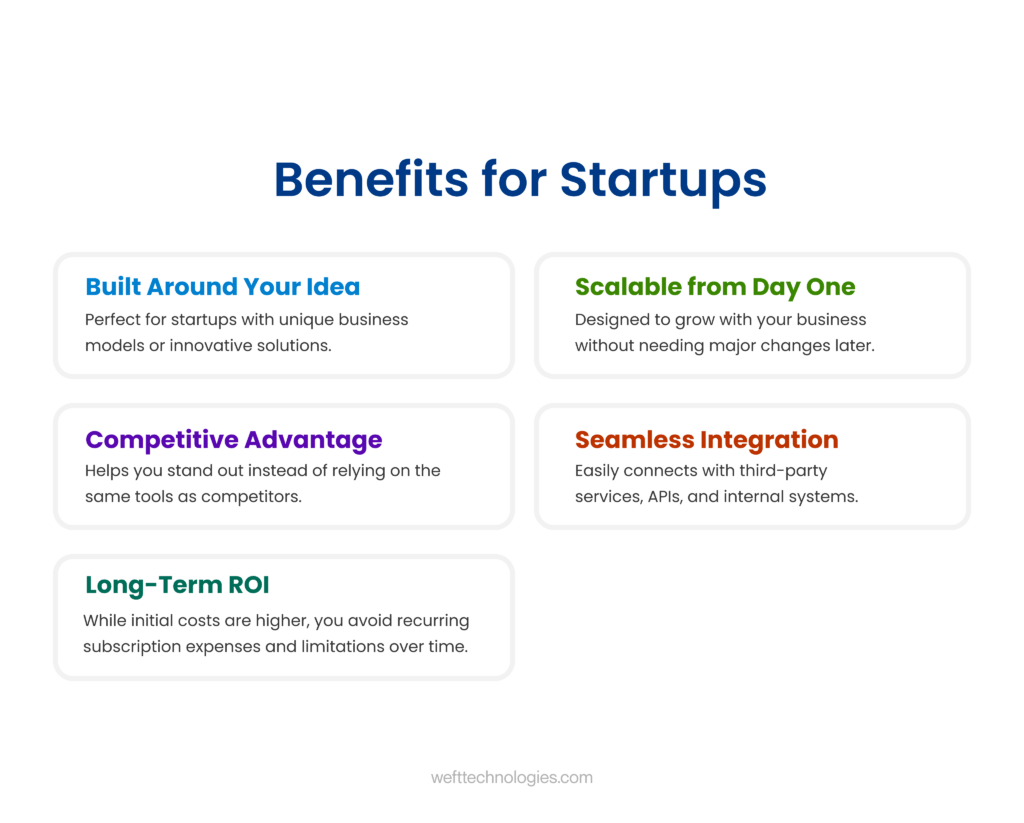
For startups aiming to scale, custom software development becomes a strategic investment rather than just a technical choice.
Off-the-Shelf Software: Pros and Limitations
Off-the-shelf tools are often the first choice for startups because they offer speed and affordability. However, while they solve short-term needs, they may introduce challenges as your business grows and becomes more complex.
Advantages
- Quick Setup: Launch your operations within days.
- Lower Initial Cost: Ideal for startups with limited budgets.
- Ease of Use: Minimal technical expertise required.
- Proven Reliability: Widely tested and used across industries.
Limitations
- Limited Customization: You adapt your business to the tool, not the other way around.
- Scalability Challenges: May not support long-term growth or complex needs.
- Hidden Costs: Add-ons, upgrades, and integrations can increase expenses.
- Integration Issues: Connecting multiple tools can become inefficient.
- Lack of Differentiation: Competitors may be using the same platforms.
Understanding these off-the-shelf software limitations is crucial before making a decision.
Custom vs Off-the-Shelf: When to Choose What
There is no one-size-fits-all answer when it comes to choosing the right software approach. The best decision depends on your startup’s current stage, available resources, and long-term vision.
Choose Custom Software When:
- Your idea is unique or technology-driven
- You plan for long-term growth and scaling
- You need advanced integrations or AI features
- Your product is your core business
Choose Off-the-Shelf Software When:
- You’re in the early validation stage
- You need to launch quickly
- The budget is limited
- Your requirements are simple and standard
Many tech startups in Dubai begin with off-the-shelf tools and later transition to custom solutions as they grow.
Key Factors to Consider Before Choosing
Beyond features and pricing, several strategic factors influence whether your software choice will support or limit your startup’s growth. Especially in a competitive ecosystem like Dubai, these considerations can make a significant difference.
1. Scalability– Your software should support future growth without major disruptions.
2. Cost vs ROI– Off-the-shelf tools are cheaper upfront, but custom solutions offer better long-term returns.
3. UAE Compliance– Ensure your software aligns with local regulations, VAT systems, and data policies.
4. Localization– Arabic language support, regional integrations, and user behavior matter in Dubai.
5. Integration Capabilities– Your product should connect smoothly with payment gateways, logistics systems, and CRMs.
6. AI Readiness– Modern digital solutions for Dubai startups require AI-driven capabilities for automation and insights.
The Role of MVP Development for Startups in Dubai
For many founders, the decision between custom and off-the-shelf doesn’t have to be immediate or absolute. This is where MVP (Minimum Viable Product) development plays a crucial role.
An MVP allows you to take a balanced approach by building only the core features needed to validate your idea in the market.
- Launch quickly with core features
- Validate your idea in the market
- Reduce risk and development cost
- Gather real user feedback
- Scale into a full product later
This approach is widely used in software development for startups and helps balance speed with flexibility.
Why the Right Tech Partner Matters
While choosing between software options is important, having the right technology partner is what ensures successful execution. Many startups fail not because of the idea, but because of poor technical decisions or a lack of guidance.
A reliable digital product development company in Dubai helps you:
- Select the right approach for your stage
- Avoid costly technical mistakes
- Build scalable and future-ready products
- Align technology with business goals
For non-technical founders, this guidance is invaluable.
Why Weft is the Right Partner for Startup Product Development
In a market where speed, innovation, and scalability define success, startups need more than just development support, they need a strategic partner.
Weft stands out as a trusted partner for startup product development in Dubai, offering:
- AI-first product engineering approach
- Expertise in MVP and scalable product development
- End-to-end product development services
- Deep understanding of startup ecosystems
- Focus on performance, UX, and growth
Whether you’re launching your first product or scaling to the next stage, Weft helps you build with clarity and confidence.
Choosing between custom software and off-the-shelf solutions is a strategic one that shapes your startup’s future. Off-the-shelf tools can help you start fast, but custom software provides the flexibility and scalability needed for long-term success. The key is to align your decision with your vision, growth plans, and market demands.
For startups in Dubai, the smartest approach is often to start lean, validate quickly, and scale with the right technology foundation.Looking to build a scalable, AI-powered product?
Partner with Weft, a leading digital product development company in Dubai, and turn your startup idea into a future-ready solution. Build scalable software solutions in Dubai with Weft Technologies.