

Most founders in the UAE do not have a bad idea problem. They have a bad execution problem. They spend six months building a product nobody asked for. They add fifteen features when three would have been enough. And then, they wonder what went wrong.
Here is what went wrong. They skipped the most important step in building a digital product: proving the idea before scaling it. That is what MVP development is actually for. Not to build something cheap. Not to release something half-finished. But to build the right thing first — learn from it, and then build more.
This is the guide we wish more UAE founders had read before they started. It will walk you through:
- What MVP development really means
- How the MVP development process works
- What it costs in the UAE market specifically
- What are the business benefits
- What are some common mistakes to avoid
What is an MVP?
An MVP (Minimum Viable Product) is not a half-built product. It’s not a rough version. It’s not a prototype. And it’s definitely not a shortcut. An MVP is the simplest version of your product that solves a real problem and can be used by real users.
Note – That last part matters. If users can’t use it, it’s not an MVP.
Here is a simple example to help you understand better:
Let’s say you’re building a logistics platform.
Wrong MVP:
- shipment tracking
- analytics dashboard
- multi-carrier integration
- AI predictions
- mobile app
- reporting suite
Right MVP:
- basic shipment tracking
- status updates
- simple dashboard
One solves a problem. The other tries to impress.
Real-World MVP Examples (And What They Teach Us)
Some of the biggest companies started with MVPs:
- Dropbox – validated with a video
- Airbnb – tested with a simple website
- Spotify – launched as a closed beta
What did they all do right?
- Started small
- Focused on one problem
- Iterated based on feedback
MVP vs Prototype vs Full Product
Before we get into process and cost, let us clear up the confusion that derails a significant number of UAE product builds before they even begin.
- MVP vs Prototype is not a subtle distinction – it is a fundamental one. A prototype visualizes your idea. It shows what the product might look like, how screens connect, and how the interface feels. But a prototype does not work. Users cannot actually use it to accomplish anything real. It is a sketch. On the other hand, an MVP actually works. Users can sign up, complete a flow, place an order, or do whatever the core action of your product is. The feedback you gather from a prototype is about appearance. The feedback you gather from an MVP is about behavior. Only one of those tells you whether you have a business.
- MVP vs Full Product is a question of scope and sequence. A full product build attempts to deliver everything before shipping to users. This includes all the features, all the integrations, and all the polish. The risk is enormous here as you spend months or years building on assumptions that may turn out to be wrong. By contrast, agile MVP development delivers the smallest functional version of the product first, puts it in front of real users, and uses their behavior to guide everything that comes next.
Business Benefits of MVP Development
You already know some of these benefits, like:
- faster time-to-market
- lower cost
- feedback
Let’s go deeper now:
1. Better Decision-Making
An MVP replaces assumptions with data. Instead of guessing:
- You know what users want
- You know what works
2. Stronger Product-Market Fit
Most products fail here. An MVP helps you:
- Refine your offering
- Align with real demand
3. Easier Fundraising
Investors don’t fund ideas. They fund:
- traction
- user data
- proof
An MVP gives you that.
4. Reduced Waste
Without MVP, you build features no one uses. With MVP, you build only what matters.
5. Faster Go-to-Market Strategy
In markets like the UAE, timing matters. Launching early gives you:
- First-mover advantage
- Faster learning cycles
Why MVP Development Matters in the UAE Market
There are markets where you can afford to build slowly. Where competition is thin, users are forgiving, and investors will wait. The UAE is not one of those markets.
There are thousands of active startups across the UAE. In fintech, proptech, healthtech, and logistics, new products enter the market every week. In this environment, time is the most expensive resource a founder has. Every month spent building a product that has not been validated with real users is a month competitors are learning, iterating, and capturing the market you are planning to enter.
There is something else particular to the UAE that makes MVP development especially non-negotiable. UAE investors have become significantly more sophisticated. Ideas are not enough. A polished deck is not enough. Investors want traction. They want user data. They want evidence that the market wants what you are building.
Working with a startup tech partner in Dubai who understands this dynamic makes a measurable difference. An MVP gives you the evidence investors need. Without it, you are asking them to fund a hypothesis. With it, you are asking them to fund a business.
Then there is the user expectations challenge. UAE consumers are among the most digitally active in the world. They use excellent apps every day. They compare your product to the best experiences they have encountered globally. If your MVP feels clunky or confusing, they will not give you a second chance. This means that even at the MVP stage, usability is not optional in this market.
What Does MVP Development Cost in the UAE?
This is the question every founder wants a straight answer to. Here it is:
- Simple MVPs
Single platform MVPs with straightforward user flows, minimal integrations, and no compliance requirements generally cost between AED 25,000 and AED 70,000. Think basic SaaS tools and informational apps with booking or ordering functionality.
- Mid-Complexity MVPs
Products with user authentication, payment gateway integration, dashboards, real-time data, and moderate backend complexity typically cost between AED 70,000 and AED 200,000. This is where most edtech, logistics, and B2B SaaS MVPs in the UAE sit.
- High-Complexity MVPs
Fintech products requiring compliance architecture, healthtech platforms with data privacy obligations, AI-integrated tools, or multi-sided marketplace models cost above AED 200,000 upwards.
MVP Development Process: The Weft Approach
Here is where most guides on MVP development go wrong. They give you a list of generic steps (define the problem, identify users, build, test, launch, etc) and call it a process. What they are actually giving you is a checklist, not a methodology. The difference matters enormously in practice. A checklist tells you what to do. A methodology tells you how to think.
At WEFT, we approach MVP product development in Dubai with the conviction that the most expensive thing you can build is the wrong product. Everything in our process is designed to protect against that outcome.
Step 1 – It Starts Before the Code, With Uncomfortable Questions
The first thing we do with any MVP engagement is ask the questions most software development companies in the UAE skip. Not “what features do you want?” but “what problem are you actually solving, and for whom?”
We push on assumptions. If a founder tells us their users will pay for a feature, we ask what evidence they have. If they tell us the market is underserved, we ask what they found when they spoke to potential users. If they cannot answer, that is not a problem; it tells us exactly where to start.
This discovery phase is not a formality. It is where we determine whether an MVP is even the right next step, what the simplest testable version of the idea looks like, and what success actually means for this particular product in this particular market. Understanding how to build an MVP properly begins here, not in code.
Step 2 – Prioritization
Once the problem and the user are clear, the work of scoping begins. We use a disciplined prioritization framework. Every feature gets a hard categorization: must-have (the product does not work without this), should-have (valuable but deferrable), or nice-to-have (fine to add later if the core succeeds).
Most MVP scopes, when we get involved early, shrink significantly from what the founder initially imagined. That is not a bad thing. A tighter scope means a faster launch, lower cost, and a cleaner signal from the market.
Step 3 – Design
In the UAE, users decide about your product in the first three minutes. Good UX at the MVP stage is not about aesthetics but about removing every reason a user might stop and think. Confused users do not give feedback. They leave.
Step 4 – Lean Development
Development follows design. The discipline is the same as everywhere else in the MVP development process: build only what is necessary, and build it properly.
Most founders think of MVP software architecture as a technical detail, something the developers handle. In reality, the architectural decisions made during the MVP stage shape everything that comes after. We favor a stack that enables rapid iteration now and does not require a complete rebuild when you scale. Similarly, we favor cross-platform frameworks like Flutter for mobile MVPs because they allow iOS and Android development simultaneously. For web and SaaS products, we default to tools that allow rapid iteration without accumulating technical debt.
Timeline discipline is non-negotiable. A well-scoped MVP should be buildable in 8 to 16 weeks. If it is stretching beyond that, the scope has grown. We call that out early.
Step 5 – Launch
When your MVP launches, the real work starts. We help founders define the metrics that actually matter. Not vanity numbers like downloads, but activation rates, retention curves, and the specific user behaviors that signal product-market fit. Then we use that data. Not to confirm what we expected, but to find out what the market is actually telling us. Sometimes that means iterating on the core experience. Sometimes it means removing a feature users are ignoring. And sometimes, it means something more significant: a pivot.
A Quick Note on Vibe Coding
There is a growing trend among founders today to use what is often called vibe coding – building products quickly using AI-assisted tools, no-code platforms, or rapid development frameworks. These tools can be useful at the MVP stage. They help reduce time, lower effort, and get something in front of users faster. But they do not solve the core problem. If you are not clear about what you are building, who it is for, and what problem it solves, these tools will only help you build faster in the wrong direction.
Used well, vibe coding accelerates validation. Used poorly, it accelerates waste. The difference is not the tool. It is the clarity behind it.
Use vibe coding tools when:
- You have a clearly defined problem and user
- You are testing a simple core feature or flow
- Speed of validation matters more than scalability
- You need quick iterations based on feedback
Avoid vibe coding tools when:
- Your idea is still unclear
- You are building complex systems (fintech, healthtech, etc.)
- You need long-term scalability from day one
- You are adding features without validation
The Mistakes That Kill UAE MVPs
We have seen founders in the UAE make these same mistakes consistently:
- Mistake 1 – Confusing Prototype with MVP
A prototype is not a product. If users can’t use it, you can’t validate anything.
- Mistake 2 – Overbuilding
Adding extra features, integrations, and polish before validation. This delays launch and increases risk.
- Mistake 3 – Building Too Little
Yes, this happens too. If your MVP doesn’t deliver value, users leave, and feedback becomes useless.
- Mistake 4 – Ignoring User Feedback
Some companies launch and then stop listening. That defeats the purpose of an MVP.
- Mistake 5 – Choosing the Wrong Development Partner
Not all developers understand MVP thinking. A good MVP development company in Dubai will:
- Challenge your ideas
- Reduce unnecessary features
- Focus on validation
How to Choose an MVP Development Company in the UAE
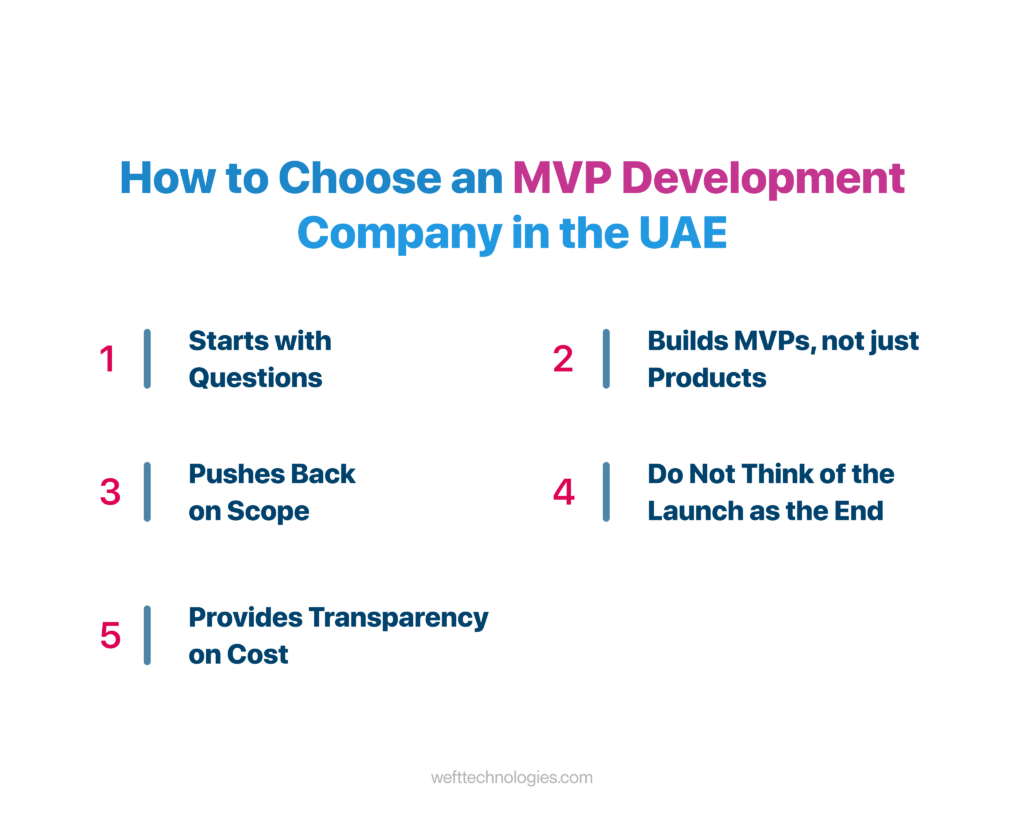
Choosing the wrong development partner is the most common reason UAE MVPs fail, not bad ideas or bad markets. So, look for a partner who:
- Starts with Questions
The right partner will start with questions, not code. They:
- Understand lean product thinking
- Have startup experience
- Focus on outcomes, not features
- Communicate clearly
Avoid companies that:
- Promise everything
- Skip discovery
- Push full-scale development early
- Pushes Back on Scope
Order-taker development teams say yes to everything. Good MVP partners tell you when something does not belong in version one, and explain why. If a company has never told you to cut a feature, they are not thinking about your product, they are thinking about billable scope.
- Builds MVPs, not just Products
There is a real difference. Enterprise software and Minimum Viable Product development require different instincts, different timelines, and a fundamentally different relationship with uncertainty. Always ask to see case studies of early-stage products they have built.
- Provides Transparency on Cost
Reliable partners break work into milestones, give you honest timelines, and tell you upfront about the factors that could move costs. Be cautious of any company that gives you a fixed price without a discovery phase – that price will change, and the change will not be in your favour.
- Do Not Think of the Launch as the End
The best MVP development partners see launch as the beginning of the engagement, not the end. They want to help you interpret the data, plan the next iteration, and use the MVP as the foundation it was designed to be.
Final Thoughts
The UAE is one of the world’s best markets to build a digital product. The ecosystem, the capital, the user base, and the government infrastructure all support it. But none of that helps if you build the wrong thing.
An MVP is not a shortcut. It is the responsible way to build. It is how you protect your time, your money, and your conviction by testing the idea before you bet everything on it. The founders and enterprises that build successfully in this market are not the ones with the biggest budgets or the most features. They are the ones who learned the fastest, adapted the earliest, and built on a foundation of evidence rather than assumption.
If you are at the stage where you have an idea worth building, the next step is not to find a development team. It is to find a product partner who will challenge your thinking, scope your MVP honestly, and help you build something that actually works for real users, in the real UAE market.
If you are ready to build something that works, let’s talk.