

Most businesses in Dubai are not behind on AI because they don’t care about it. They’re behind because they don’t know where to start, or they started wrong. They sat through an AI workshop. They ran a pilot. They hired a consultant who used the word “ecosystem” forty times in one deck. And then nothing changed.
Here’s the uncomfortable truth about AI in 2026. The technology is not the hard part. Knowing what to build, why to build it, and how to make it actually work inside a real business – that’s where most companies get stuck.
This guide is for founders and enterprise leaders who want straight answers on how AI development in Dubai actually works in 2026.
Why AI Development in the UAE Is Booming
Digital transformation used to mean one thing. Moving from manual work to software. That phase is done. Now it’s about moving from software to intelligence. Systems are no longer just tools. They are decision-makers. And Dubai is one of the fastest-growing markets for AI adoption right now. Government push. Smart city initiatives. Digital-first infrastructure. Everything is aligned for AI-driven business solutions. On paper, it looks like the perfect environment. But on the ground, things look different. Most businesses are still figuring it out. They know they should invest in AI. They just don’t know what that actually means for them. In short, the question isn’t whether to invest in AI. That ship has sailed. The question is how to do it right.
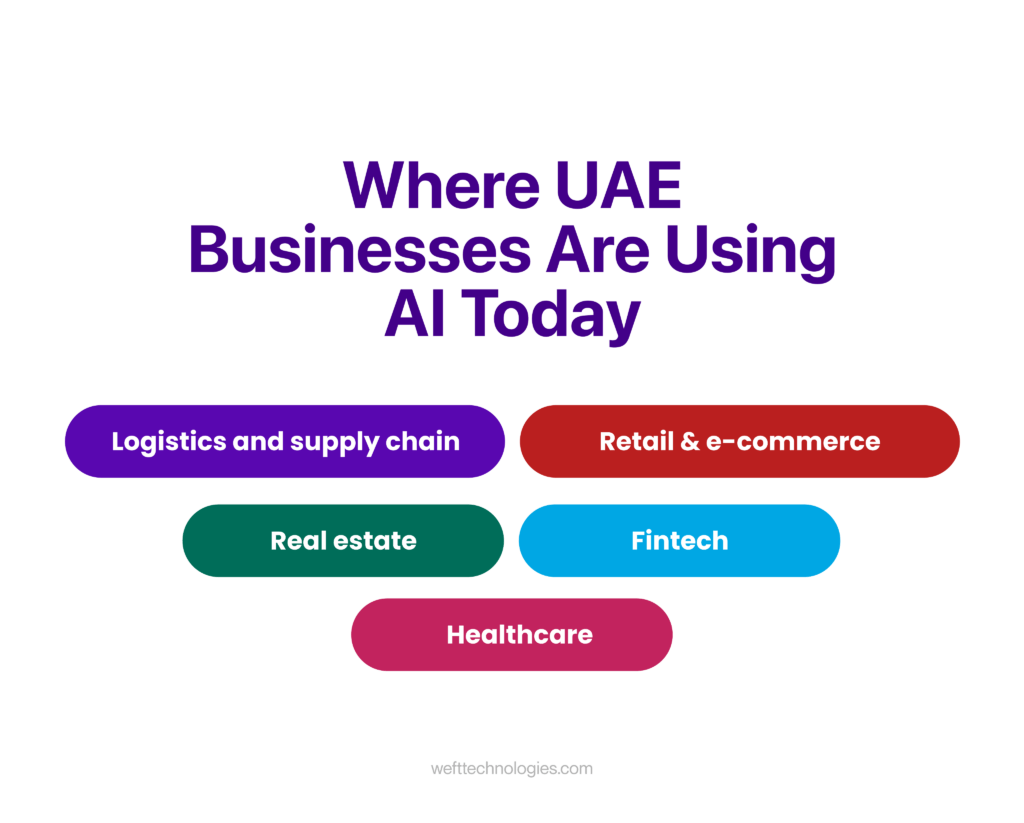
Where UAE Businesses Are Using AI Today
The sectors driving AI product development in the UAE in 2026 are the same sectors driving the broader economy. But the specific use cases are worth understanding.
- Fintech – Uses AI for fraud detection, credit risk modelling, AML compliance automation, and customer service AI.
- Logistics and supply chain – Uses AI for route optimisation, predictive fleet maintenance, customs documentation automation, and warehouse coordination.
- Real estate – Uses AI for property valuation, tenant matching, and smart building management.
- Healthcare – Uses AI for diagnostics support, clinical workflow automation, and patient triage.
- Retail & e-commerce – Uses AI for personalisation, inventory optimisation, and demand forecasting.
What the Next 2-3 Years Will Look Like
AI adoption in the UAE will grow. That’s obvious. But the real shift will be in how businesses use it. We’ll see:
- Fewer experimental projects
- More outcome-driven implementations
- Tighter integration with core operations
- Higher demand for custom AI solutions
- Stronger focus on ROI
In short, less hype. More execution.
What AI Development Means in Practice
Let’s strip this down. AI development is not building something “intelligent” just for the sake of it. Nor is it adding AI to your product because competitors are doing it. AI development is much simpler than that. It’s about using data to make a better decision than you could manually. That’s it.
A good AI solutions company in the UAE will never start with models. They start with questions like:
- Where are you losing time?
- Where are decisions inconsistent?
- Where are you relying too much on manual judgment?
Because that’s where artificial intelligence solutions actually work.
Furthermore, the term ‘AI Development’ gets applied to everything from a basic chatbot to a fully autonomous system. Here’s how to think about it practically:
- Automation AI – Handles repetitive tasks like document processing, invoice matching, query routing, and data entry.
- Predictive AI – Uses historical data to forecast what happens next. This can be used for churn prediction, demand forecasting, fraud detection, and lead scoring.
- Generative AI – Creates content, code, summaries, and conversations. This can be used in customer-facing chatbots and proposal drafting.
- Agentic AI – Executes multi-step workflows autonomously. This is where the industry is moving in 2026, and it’s where the gap between a capable AI development partner and a mediocre one becomes most visible.
The right type of AI for your business depends entirely on the problem you’re solving, the data you have, and the environment it needs to work in. Any AI solutions company in the UAE worth working with will tell you this before recommending a technology.
Cost of AI Development in the UAE (And How to Think About It)
Everyone asks this. But it’s the wrong question. Because AI development doesn’t have a fixed cost. It depends on:
- What you’re building
- How complex the problem is
- How good your data is
- How much integration is needed
Instead, ask this:
“What is the cost of not fixing this problem?”
If delays are costing you revenue, inefficiencies are slowing growth, and decisions are inconsistent, then the real cost is already there. AI just helps you recover it.
The Questions You Need to Answer Before You Build Anything
These questions are worth sitting with before you commission anything.
- Is your use case regulated?
Fintech, healthtech, or any application making decisions that affect individuals. The UAE’s AI governance framework is progressive but real, and it’s getting more specific every quarter. Compliance requirements need to be understood before building, not after.
- Do you need to build, or can you buy?
Off-the-shelf AI tools solve a significant number of business problems at a fraction of the cost of custom AI development. The right AI consulting in Dubai starts by asking whether custom development is actually necessary, or whether a configured existing solution serves the need. A partner who always recommends building from scratch is not giving you the full picture.
- Do you have a specific problem or a general desire to “use AI”?
The latter produces expensive, underutilised systems almost every time. AI works when it’s solving a defined, measurable problem. If you can’t articulate the problem in one or two sentences, start there.
When You Should NOT Invest in AI
This is important. Because not every business needs AI.
You should avoid it if:
- Your problem is simple and rule-based
- You don’t have enough usable data
- A basic software solution can fix it
- You’re doing it just to ‘keep up’
AI is not a shortcut. It’s a multiplier. If the foundation is weak, it won’t help.
Developing AI Solutions That Actually Work
What actually makes AI software development in Dubai succeed or fail is hard to put in a list. At WEFT, we’ve built enough AI systems to know where projects go wrong. Almost always, it’s before the first line of code is written.
- Start with the Problem
The most expensive AI project is the one solving the wrong problem. Before anything else, you need to be able to answer: what decision or task are we trying to improve? What does the current process look like, and where exactly does it break down? How will we measure success in six months?
That last question is more important than people realise. If you can’t define what success looks like in measurable terms, you won’t know if your AI is working. And you won’t be able to justify the next phase of investment.
- Look at the Data
The data conversation is where a lot of enterprise AI projects in Dubai hit their first wall. The data exists technically, but it’s sitting in three different legacy systems. It’s inconsistently labelled. There are gaps. There’s no clear ownership. That’s not a technology failure. That’s a scoping failure that happened before development started.
Good custom AI development in Dubai includes an honest data assessment before a single model is proposed. If your partner skips this step, they’re either inexperienced or they’re hoping you won’t notice the problem until you’re already committed.
- Architecture that Scales
Scalable AI systems don’t happen by accident. The architectural decisions in this phase determine whether your AI solution grows with your business or requires a complete rebuild eighteen months from now. That’s a conversation worth having explicitly with any enterprise AI company in Dubai you’re considering.
For UAE deployments specifically, Arabic language requirements need to be addressed in model selection, not discovered after deployment. Data residency is the other UAE-specific consideration. Regulated sectors need AI systems that store and process data within UAE borders. This has infrastructure implications that need to be designed in from the start.
- Build, Test & Iterate
Development follows architecture. For most business AI applications, this means iterative cycles – building, testing against real scenarios, refining. Not building the whole thing and then testing. The goal at this stage is not a perfect system. It’s a working system that teaches you something. What’s the activation rate? Where do users drop off? What edge cases does the model handle badly? These answers shape the next iteration.
- Integration and Continued Monitoring
An AI model that lives in isolation from your existing systems delivers limited value. Integration with your CRM, ERP, data warehouse, or customer-facing applications is where AI-driven business solutions become real. And then ongoing monitoring matters more than most people plan for. Models drift as the world changes. Data distributions shift. New edge cases emerge. A responsible AI development process includes a plan for ongoing monitoring, retraining, and governance.
Why AI Projects Fail
Gartner predicts that through 2026, organizations will abandon 60% of AI projects unsupported by AI-ready data. Not because the AI didn’t work. Because the foundation wasn’t there.
Here are a few reasons why AI solutions fail:
- Starting with the Technology, Not the Problem
Businesses decide they want machine learning or a large language model and then search for a use case to justify it. The result is a technically functional system solving a problem nobody cared about enough to validate.
Solution – Start with the problem. Let the technology follow.
- Underestimating the Data Problem
The pitch sounds simple. “We have the data, you build the model.” The reality is almost always messier. Data is siloed. Quality is inconsistent. Volume is insufficient. The right partner surfaces this in discovery. The wrong one discovers it mid-build, when fixing it costs three times as much.
Solution – Before building anything, audit your data, clean it, and connect it across systems.
- Ignoring Arabic
For any AI system interacting with Arabic-speaking users in the UAE, Arabic language performance is not optional.
Solution – Build Arabic NLP in from the model selection phase.
- Choosing a Vendor Instead of a Partner
A vendor delivers what you specify. A partner challenges what you specify, identifies what you haven’t thought of, and stays accountable for outcomes, not just deliverables. In a domain as technically complex as AI, that distinction matters more than any other.
Solution – Always choose an experienced partner over a vendor.
How to Choose an AI Solutions Company in the UAE
The market has expanded fast. The quality range is wide. Here’s what actually matters:
- They’re honest about what AI can’t do
The best AI development company in Dubai tells you when AI is the wrong solution for your specific problem.
- They ask about your data before they talk about your model
This is the clearest early signal of technical maturity. Any company that proposes a solution without a serious conversation about your data infrastructure is skipping the most important step.
- They have UAE-specific experience
Arabic NLP, data residency architecture, and regulatory familiarity – these don’t transfer automatically from experience in other markets. Ask specifically about UAE deployments. Ask what went differently here compared to elsewhere.
- They can tell you what happened six months after deployment
Case studies that stop at launch are incomplete. Ask what the system looks like six months later. Is it still running? Has it been retrained? What did they learn? A partner proud of post-launch outcomes will talk about them readily.
- They have a view on AI governance
Responsible AI is a regulatory direction of travel in the UAE. Your development partner should have a clear point of view on how the systems they build are monitored, audited, and governed.
Final Thoughts
The UAE is not waiting for the rest of the world to figure out AI. It’s setting the pace with policy, with investment, with infrastructure, and with high AI adoption rates. For businesses operating in this market, the strategic question isn’t whether to invest in AI development. It’s how to do it in a way that builds real capability and delivers measurable value. That means starting with the right problem. Being honest about your data. Choosing a partner who challenges your thinking before they write your code. And planning for the long game because AI isn’t a project with a finish line. It’s a capability you build over time.
At WEFT Technologies, we help founders and enterprises in the UAE build AI systems that actually work – not just in a demo, but in production, integrated into real workflows, and improving over time. From AI strategy and data engineering to custom model development and deployment, we bring product thinking to AI.
If you’re serious about AI development in the UAE and want a partner who’ll tell you what you need to hear, not just what you want to hear – let’s talk.