
Most businesses don’t fail because of bad ideas. They struggle because their systems can’t keep up. In the initial stages, everything works. Spreadsheets manage operations. Basic tools handle customers. Teams find quick ways to get things done. But the moment your business starts picking up real momentum is often the same moment your systems start quietly falling apart. In short, growth starts creating problems instead of opportunities. This is where the necessity of enterprise software arises.
Enterprise software is a system that supports how a business operates, scales, and evolves. Especially in a market like Dubai, where competition moves fast, and customer expectations are high, the way your systems are built directly impacts how far your business can go. This is why more companies here are now working with digital transformation companies in the UAE to move away from patchwork solutions and build something more solid underneath – systems that actually support growth instead of quietly resisting it.
This blog breaks down what enterprise software development really involves, what makes it different, and why getting it right is one of the most important decisions a scaling business can make.
What is Enterprise Software Development?
Enterprise software development is the process of designing and building software systems that support large-scale business operations. But that definition doesn’t explain its real value. Let’s simplify it.
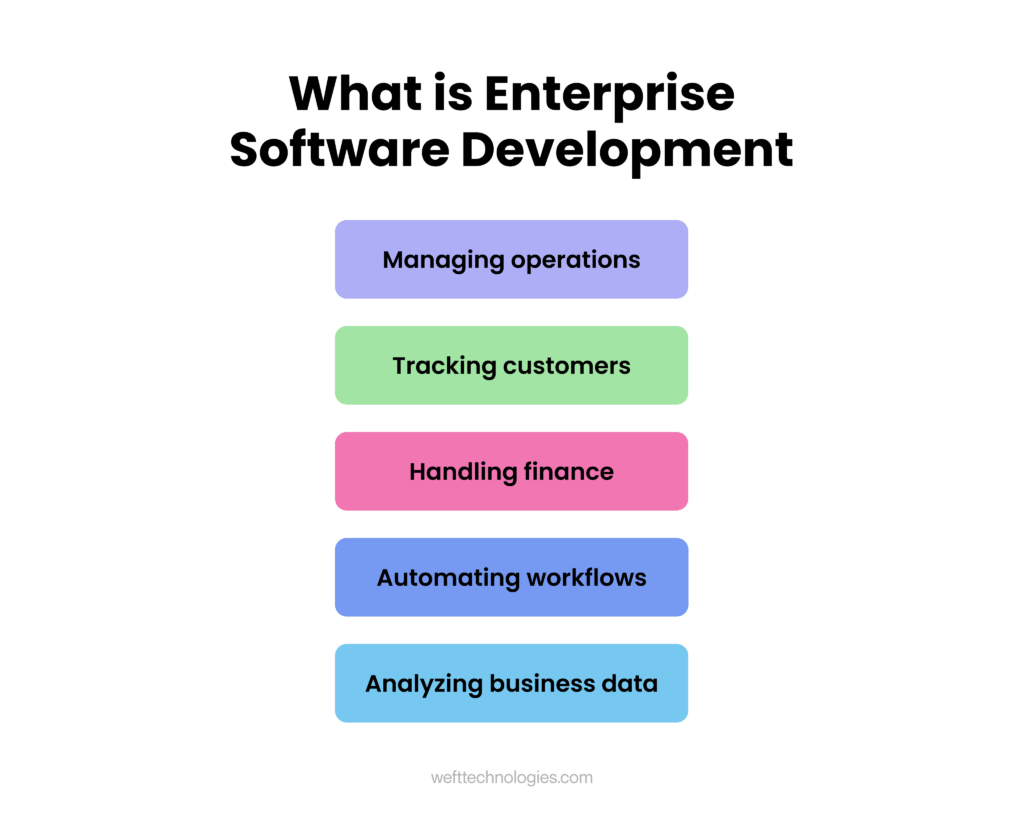
Enterprise software is the system that runs your business. It connects your operations, people, and data into one structured flow. Instead of using multiple disconnected tools, businesses use enterprise applications to manage everything in one place. This can include:
- Managing operations
- Tracking customers
- Handling finance
- Automating workflows
- Analyzing business data
Unlike off-the-shelf tools, enterprise software is built around your business. It adapts to your processes instead of forcing you to adapt to it. That is what makes custom enterprise software development so powerful.
What Makes Enterprise Software “Enterprise”?
Not every application qualifies as enterprise software. Enterprise systems are built with scale, performance, and complexity in mind. They are designed to handle:
- Large volumes of data
- Multiple users across departments
- Complex business processes
- Integration with multiple systems
They also focus heavily on:
- Security
- Reliability
- Performance
- Long-term scalability
This is where working with an experienced enterprise software development company becomes important. Because building enterprise systems is not just about coding features. It is about designing a foundation that can support business growth for years.
Custom Enterprise Software vs Off-the-Shelf Software
Many businesses start with off-the-shelf software.
- They are quick to set up.
- They are affordable in the beginning.
- They solve immediate problems.
But over time, limitations become clear. These ready-made tools:
- Works the same way for every business
- Offers limited flexibility
- Struggles with complex workflows
- Creates dependency on multiple tools
On the other hand, custom enterprise software is different. It is designed specifically for your business model. It allows:
- Custom workflows
- Seamless integrations
- Scalable architecture
- Better control over data and processes
This is why growing companies eventually move toward custom enterprise web application development and fully customized systems.
Key Challenges
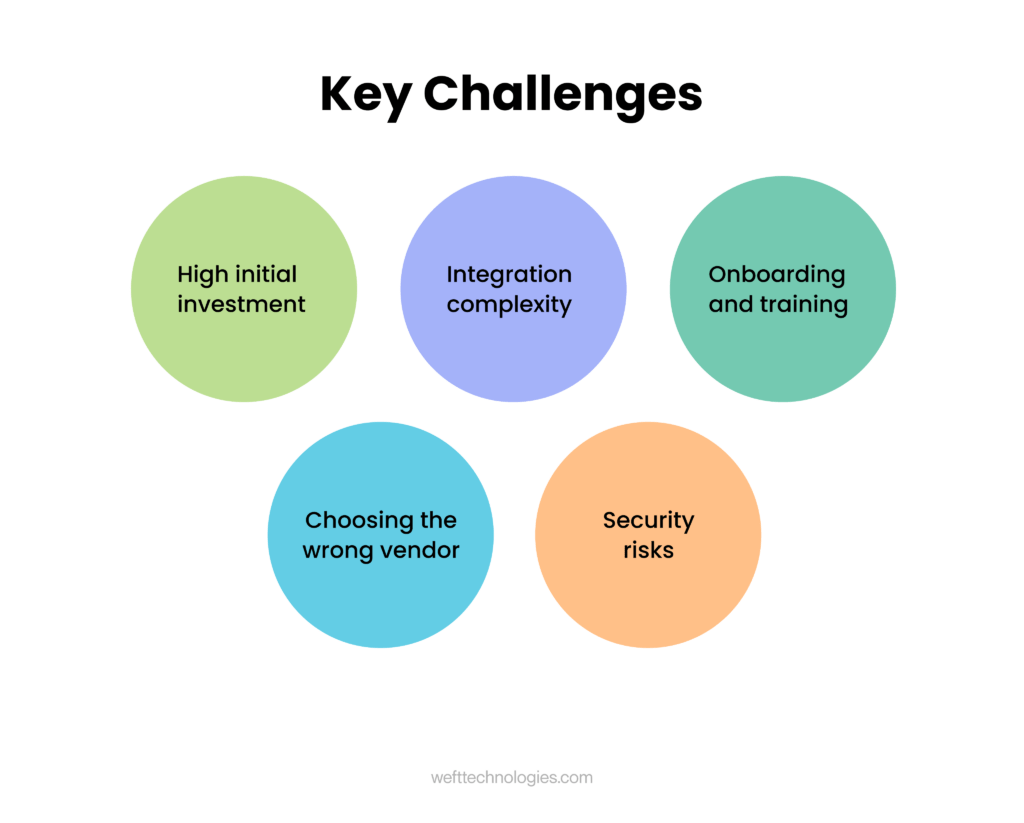
Enterprise software can transform a business. But there are real challenges involved, like:
- High initial investment
- Integration complexity
- Onboarding and training
- Security risks
- Choosing the wrong vendor
All these challenges are real. But they are manageable with the right expertise. Just partner with an experienced enterprise software development company and build your system the right way.
Factors that Impact the Cost of Enterprise Software Development
Let’s address the question every business asks. How much does it cost? The honest answer is that it depends on the following factors:
- Scope of the project
- Integration required
- Scale of the application
- Technology and infrastructure
Does Enterprise Digital Transformation Matter in Today’s Market?
In competitive regions like Dubai and the UAE, businesses cannot afford slow systems. Speed matters. Efficiency matters. Customer experience matters. Hence, companies that invest in enterprise software implementation gain a clear advantage because:
- They operate faster
- They adapt quickly
- They scale without friction
This is why enterprise software is no longer a luxury. It is the foundation of modern business growth.
Why Modern Businesses Need Enterprise Software
The way businesses operate has changed:
- Customers expect faster service
- Markets move quickly
- Competition is global
But many businesses still rely on outdated systems. And that creates a gap.
The Reality Most Businesses Face
Let’s look at what happens inside growing companies:
- Teams use different tools that don’t connect
- Data is stored in multiple places
- Reports take time to compile
- Manual processes increase errors
- Scaling operations becomes difficult
These problems don’t always show up immediately. But they slow down growth over time.
How Enterprise Software Solves These Problems
Enterprise software brings everything together. Instead of working in fragments, your business operates as one system. It enables:
- Better operational efficiency
- Real-time data access
- Seamless collaboration
- Scalable infrastructure
- Improved customer experience
This is the core of enterprise digital transformation. It is not just about adopting technology. It is about rethinking how your business operates using the right systems.
Common Business Challenges And How Enterprise Software Solves Them
Most businesses don’t realize they have a system problem. They think it’s an operations issue, a team issue, or a growth problem. But in many cases, the real issue sits underneath. Their systems are not built to scale.
Here’s a visualization of the most common challenges and how the right enterprise software solves them.
| Business Challenge | How Enterprise Software Solves It |
| Disconnected Systems & Data Silos | Departments get connected into a single source of truth and data flows in real time |
| Manual Processes & Inefficiencies | Workflow automation reduces manual effort, minimizes errors, and improves speed |
| Lack of Real-Time Visibility | Real-time dashboards and analytics provide instant insights for faster, data-driven decisions |
| Scalability Limitations | Scalable architecture and cloud-based infrastructure support growth without disruption |
| Poor Customer Experience | Integrated CRM and data systems enable faster responses and personalized customer journeys |
| Integration Challenges | API-driven architecture allows seamless integration with existing and new systems |
| Security & Compliance Risks | Built-in security features like encryption, access control, and compliance frameworks protect data |
| High Operational Costs | Automation and optimized workflows reduce costs and improve operational efficiency |
The Bigger Insight
If you’re facing any of these challenges, the issue is not isolated. The root problem is disconnected, outdated systems. So, you need more than quick fixes. You need a structured approach. In other words, what you need is an enterprise digital transformation.
Enterprise Software Development Lifecycle
No serious enterprise system gets built in one go. And the ones that try usually end up being rebuilt from scratch a year later.
The reality is that enterprise software touches too many parts of a business to be rushed. Every decision made early – how the system is structured, how data flows, how it connects with other tools – shapes how the whole thing performs down the line. A shortcut taken during planning doesn’t stay in planning. It shows up later, usually at the worst possible time, when the business is growing, and the system simply can’t keep up.
This is why the development lifecycle matters. Not as a process for its own sake, but because skipping stages has real consequences. Here’s how the process actually works, stage by stage:
Planning and Discovery
Everything starts here. Before writing a single line of code, you need to understand the business.
This stage focuses on:
- Identifying business goals
- Understanding workflows
- Mapping existing systems
- Defining requirements
- Identifying challenges and gaps
This is where most projects succeed or fail. If the foundation is unclear, the system will not solve the real problem. A good enterprise software development company spends time here. Because building the wrong solution faster is still the wrong solution.
UI/UX Design
Enterprise software is often complex. But complexity should never reach the user. This is where UI/UX design plays a critical role. The goal is to make the system intuitive.
This stage includes:
- User journey mapping
- Wireframing and prototyping
- Designing dashboards and interfaces
- Ensuring usability across devices
Good design reduces training time. It improves adoption across teams. Because even the most powerful system fails if people don’t use it properly.
System Architecture
This is the technical backbone of the system. Architecture defines how everything is structured behind the scenes.
It focuses on:
- System design and components
- Database structure
- Scalability planning
- Performance optimization
- Security architecture
At this stage, decisions are made for the long term.
- Can the system handle growth?
- Can it support integrations?
- Can it process large volumes of data?
This is where digital product engineering becomes critical. Because you are not just building for today. You are building for future scale.
Development
This is where the system starts taking shape. Developers build the actual application based on the approved designs and architecture.
This includes:
- Backend development
- Frontend development
- API development
- Feature implementation
Integration
Enterprise software does not work in isolation. It needs to connect with other systems.
This could include:
- ERP systems
- CRM platforms
- Payment gateways
- Third-party tools
- Legacy systems
Integration ensures that data flows smoothly across systems.
Testing and Quality Assurance
Before deployment, everything needs to be tested. Not just for bugs but for performance, security, and usability.
This stage includes:
- Functional testing
- Performance testing
- Security testing
- User acceptance testing
Deployment
Once the system is ready, it is deployed. But deployment is not just about launching.
It involves:
- Setting up production environments
- Data migration
- System configuration
- Monitoring initial performance
Security Implementation
Security is not a one-time step. It is built into every stage but also reinforced separately.
Enterprise systems deal with sensitive data. So they must include:
- Data encryption
- Access control
- Compliance measures
- Threat detection systems
Maintenance and Continuous Improvement
The system does not end after deployment. In fact, this is where the real journey begins. Businesses evolve. Markets change. Technology advances. Your software needs to keep up.
This stage includes:
- Regular updates
- Performance monitoring
- Bug fixes
- Feature enhancements
- Scaling infrastructure
This is why enterprises look for end-to-end software development services. Because long-term support is just as important as development.
Why The Enterprise Software Development Lifecycle Matters
Many businesses underestimate this process. They focus only on development. But enterprise software is not just about building. It is about building the right way.
A structured lifecycle ensures:
- Fewer risks
- Better performance
- Long-term scalability
- Higher return on investment
This is the foundation of successful enterprise digital transformation.
Types of Enterprise Software Every Business Should Know
Not all enterprise software does the same job. Each system solves a specific business problem. But together, they create a connected ecosystem.
Let’s break down the most important types of enterprise software and where they fit.
- Enterprise Resource Planning (ERP) Systems
ERP systems bring your core business operations into one place. Instead of managing finance, inventory, procurement, and operations separately, everything is connected. Think of it as the backbone of your business.
With an ERP system, you can:
- Manage financial data in real time
- Track inventory and supply chains
- Monitor operations across departments
- Reduce manual work and duplication
For growing businesses, ERP is often the first step toward enterprise software implementation. Without it, operations become difficult to scale.
- Customer Relationship Management (CRM) Systems
CRM systems focus on one thing – your customers. They help you track every interaction, from the first inquiry to long-term engagement. Instead of scattered customer data, everything stays in one place.
A CRM system helps you:
- Manage leads and sales pipelines
- Track customer communication
- Improve follow-ups and conversions
- Personalize customer experiences
For businesses focused on growth, CRM is essential. It directly impacts revenue and customer satisfaction.
- Human Resource Management (HRM) Systems
As teams grow, managing people becomes complex. HRM systems simplify this. They handle everything related to employees in one system. This includes:
- Recruitment and onboarding
- Attendance and payroll
- Performance management
- Employee records
Without a structured HR system, companies often face inefficiencies and compliance issues. HRM software ensures smooth internal operations.
- Enterprise SaaS Platforms
Software-as-a-Service (SaaS) has changed how businesses use software. Instead of installing and maintaining systems locally, businesses access software through the cloud.
Enterprise SaaS platforms are:
- Scalable
- Accessible from anywhere
- Easy to update and maintain
This is why enterprise SaaS development is growing rapidly. Businesses prefer flexible solutions that don’t require heavy infrastructure.
- Workflow Automation Tools
Every business has processes that run on repeat. Approvals, data entry, notifications, report generation – tasks that eat up time without adding much thinking. Automation tools take those off your team’s plate.
They help you:
- Automate routine processes
- Reduce human error
- Improve speed and efficiency
- Ensure consistency across operations
This is a key part of building AI-powered enterprise applications and automation-driven systems.
- Custom Enterprise Applications
Not every business fits into standard software. That’s where custom applications come in. These are built specifically for your workflows, your industry, and your goals.
Custom enterprise software allows you to:
- Design systems around your processes
- Integrate multiple tools into one platform
- Solve unique operational challenges
- Build a competitive advantage
This is the core of custom enterprise software development. Instead of adjusting your business to software, the software adapts to you.
- Business Intelligence (BI) and Data Analytics Tools
Data is one of the most valuable assets in any business. But raw data alone is not useful. BI tools turn data into insights.
They help you:
- Track performance metrics
- Analyze trends
- Make data-driven decisions
- Identify opportunities and risks
This is where data engineering and analytics play a major role in modern enterprise systems.
- Supply Chain and Logistics Management Systems
For businesses dealing with operations, logistics, or distribution, this is critical.
These systems help manage:
- Inventory movement
- Order fulfillment
- Transportation
- Warehouse operations
They bring visibility into complex processes and reduce delays and errors.
How These Systems Work Together
Individually, each system solves a problem. But the real value comes when they are connected. Your ERP talks to your CRM. Your CRM connects with your marketing tools. Your HR system integrates with operations. Your analytics tools pull data from everywhere. This creates a unified ecosystem. And that is what true enterprise digital transformation looks like.
What This Means for Your Business
Most businesses don’t need just one system. They need the right combination. The goal is not to use more software. The goal is to use the right software, connected in the right way. This is where working with an experienced enterprise software development company makes a difference. Because choosing, building, and integrating these systems requires a clear strategy.
A Checklist for Choosing the Right Enterprise Software Partner
Here’s a simple checklist to help you choose the right enterprise software partner:Look for domain expertise
- Look for domain expertise
- Focus on scalability
- Check integration capabilities
- Prioritize UI/UX
- Ensure long-term support
How Weft Ticks All These Boxes
How Weft Ticks All These Boxes
Domain expertise
Weft starts by understanding your business. Every solution is aligned with your workflows, your challenges, and your goals.
Scalability
From the start, systems are designed to grow with your business. Whether you scale users, data, or operations, the system adapts without friction.
Integration capabilities
Weft builds connected ecosystems. Your ERP, CRM, third-party tools, and internal systems work together without silos.
UI/UX
Our user-first approach ensures clean interfaces and intuitive workflows.
Long-term support
Weft does not stop at deployment. As a trusted partner for enterprise software development in Dubai, the focus is on continuous improvement, support, and long-term value.
Conclusion
Enterprise software is no longer optional. Especially in fast-moving markets like Dubai, the difference is clear. Businesses that invest in enterprise software development move faster. They adapt quicker. They scale without breaking. And over time, they pull ahead. Because the real advantage is not just having better ideas. It is in having systems that can support those ideas at scale.