

As businesses across the UAE accelerate their digital transformation efforts, SaaS (Software as a Service) has become a preferred model for building scalable, cost-effective, and cloud-based applications. From startups and SMEs to large enterprises, organizations are investing in SaaS solutions to streamline operations, improve customer experiences, and drive growth.
Whether you’re planning to launch a new SaaS product or modernize existing systems, understanding the SaaS development process is essential. This guide covers everything you need to know about SaaS application development in UAE, including development stages, costs, technology trends, AI integration, and choosing the right SaaS development company in Dubai, UAE.
What is SaaS Application Development?
SaaS application development refers to the process of building cloud-based software that users can access through the internet without installing or maintaining infrastructure locally. Instead of purchasing software licenses and managing servers internally, businesses subscribe to software platforms hosted in the cloud.
Unlike traditional software systems, SaaS platforms are designed for scalability, remote accessibility, automatic updates, and subscription-based delivery. This makes them highly attractive for modern businesses that need flexibility and rapid growth.
Popular examples of SaaS products include:
- CRM platforms
- Project management tools
- HR and payroll systems
- Accounting software
- AI-powered business platforms
Today, saas application development in Dubai is evolving beyond basic cloud software into intelligent, AI-driven ecosystems that continuously adapt to user needs.
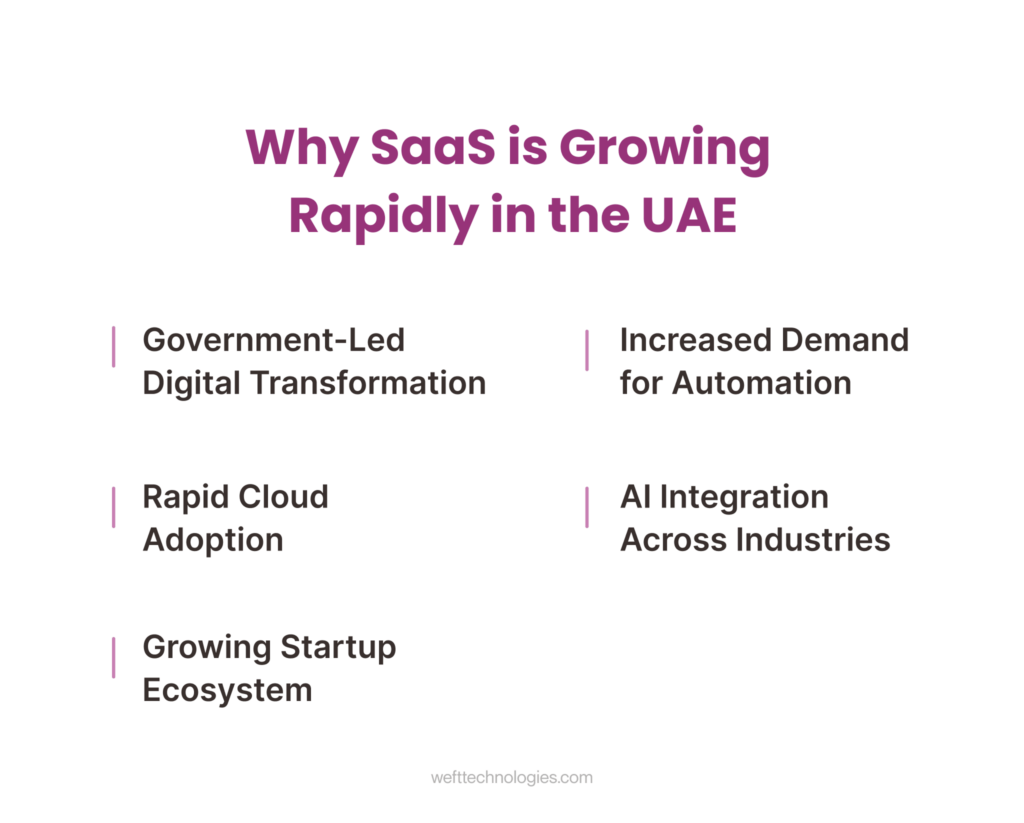
Why SaaS is Growing Rapidly in the UAE
The UAE has created one of the strongest environments for SaaS innovation in the region. Several factors are contributing to this rapid growth.
- Government-Led Digital Transformation– Initiatives like UAE Vision 2031, Smart Dubai, and AI-focused policies are encouraging businesses to adopt cloud-based technologies and digital infrastructure.
- Rapid Cloud Adoption– Businesses across the UAE are moving toward cloud-native operations to improve scalability, flexibility, and operational efficiency.
- Growing Startup Ecosystem– Dubai’s startup ecosystem is attracting founders and investors looking to build scalable SaaS platforms across industries.
- Increased Demand for Automation– Organizations are investing in enterprise SaaS solutions to automate workflows, improve productivity, and reduce operational complexity.
- AI Integration Across Industries– The rise of AI-powered SaaS applications is transforming how companies operate, especially in fintech, logistics, healthcare, and enterprise management.
Key Industries Driving SaaS Demand in UAE
The growing need for custom SaaS development in the UAE is especially strong in industries requiring scalability, automation, and data-driven operations.
| Industry | SaaS Use Cases |
| Logistics | Fleet managementWarehouse automationShipment tracking |
| Fintech | Digital paymentsCompliance platformsAI analytics |
| Healthcare | TelemedicinePatient management systems |
| Real Estate | Property managementCRM platforms |
| Education | E-learning platformsStudent management |
| Enterprise Operations | HRMSERPWorkflow automation |
Complete SaaS Application Development Process
Building a successful SaaS platform requires more than coding. It involves strategic planning, scalable architecture, user-centric design, and continuous optimization. Below is a step-by-step breakdown of the SaaS application development process followed by leading SaaS product development agencies.
1. Market Research & Validation
Before development begins, businesses must validate their idea by identifying customer pain points, market demand, and competitors. This stage helps reduce risk and ensures product-market fit.
2. SaaS MVP Development
A Minimum Viable Product (MVP) helps startups launch quickly with core features while validating the product in real market conditions.
SaaS MVP development allows businesses to:
- Reduce initial development costs
- Gather early user feedback
- Test monetization strategies
- Improve faster through iterations
3. UI/UX Design
A strong UI/UX strategy improves engagement and customer satisfaction. Modern SaaS platforms should focus on clean interfaces, responsive design, seamless navigation, and user-centric workflows.
4. Choosing the Right Tech Stack
Choosing the right technology stack will determine performance, scalability, and long-term maintainability. Key considerations include:
- Frontend frameworks
- Backend technologies
- Cloud infrastructure
- Database systems
- AI integration capabilities
5. Cloud Infrastructure & Multi-Tenant Architecture
Most modern SaaS platforms use cloud-native and multi-tenant architectures where a single application serves multiple customers while securely separating their data.
Benefits:
- Lower infrastructure costs
- Easier maintenance
- Better scalability
- Faster updates
6. Backend & Frontend Development
This stage focuses on building application logic, APIs, dashboards, integrations, and frontend experiences. Modern SaaS software development services prioritize:
- API-first development
- Modular architecture
- Scalable microservices
- High application performance
7. AI Integration in SaaS Applications
Successful SaaS products are expected to include AI-powered capabilities that improve efficiency, automate repetitive tasks, and deliver personalized experiences. This helps with predictive analytics, intelligent automation, AI copilots, and many more. Businesses investing in AI-powered SaaS applications gain stronger operational efficiency and user engagement.
8. Cybersecurity & Compliance
As SaaS applications handle increasing amounts of sensitive business and customer data, security must be built into the product from day one rather than treated as an afterthought. For UAE businesses, compliance and secure infrastructure are essential for trust and scalability.
Important considerations include:
- Data encryption
- Identity and access management
- GDPR and UAE compliance
- Cloud security best practices
- Continuous monitoring
9. Testing & Quality Assurance
Before launch, the SaaS platform must undergo extensive testing to ensure reliability, performance, and security. Even minor issues can negatively impact user experience and customer retention. Comprehensive testing ensures the SaaS application performs reliably across devices and user environments.
Types of SaaS testing
- Functional testing
- Performance and load testing
- Security testing
- Automation testing
- Cross-browser and cross-device testing
- User acceptance testing (UAT)
10. Deployment & Scaling
After launch, SaaS platforms require continuous optimization, monitoring, and scaling. Cloud-native deployment enables:
- Faster updates
- Global scalability
- Better uptime
- Automated CI/CD pipelines
Here’s a s table that simply gives an insight into SaaS Development Lifecycle at a Glance
| Stage | Primary Goal |
| Market Research & Validation | Validate demand and identify market opportunities |
| MVP Development | Launch quickly and test assumptions |
| UI/UX Design | Create intuitive user experiences |
| Technology Selection | Build a scalable technical foundation |
| Cloud Architecture | Enable scalability and efficiency |
| Development | Build core product functionality |
| AI Integration | Add intelligent automation and insights |
| Security & Compliance | Protect data and ensure trust |
| Testing & QA | Deliver a reliable, high-quality product |
| Deployment & Scaling | Grow and optimize the platform continuously |
AI-Powered SaaS Applications: The Future of SaaS in UAE
Artificial Intelligence is rapidly transforming SaaS applications from basic cloud software into intelligent platforms that can automate processes, analyze data, and deliver personalized user experiences. As businesses across the UAE accelerate their digital transformation efforts, AI-powered SaaS solutions are becoming a key driver of innovation and operational efficiency.
Modern SaaS platforms are integrating AI capabilities such as:
- Workflow automation
- Predictive analytics
- AI-powered chatbots and virtual assistants
- Smart recommendations
- Customer behavior analysis
- Intelligent reporting and insights
Industries including logistics, healthcare, fintech, real estate, and enterprise operations are increasingly adopting AI-powered SaaS applications to improve decision-making, reduce costs, and enhance customer experiences.
With Dubai’s strong focus on AI innovation and smart technologies, AI-powered SaaS is expected to play a central role in the future of business software across the UAE.
Cost Factors for SaaS Development in UAE
The cost of developing a SaaS application in the UAE can vary significantly depending on the product’s complexity, features, technology requirements, and long-term scalability goals. While there is no fixed price for SaaS development, understanding the key cost drivers can help businesses plan their budgets more effectively and avoid unexpected expenses.
- Project Complexity
A simple SaaS MVP with basic features will cost considerably less than a feature-rich enterprise platform with advanced workflows, analytics, and integrations. - UI/UX Design Requirements
Custom user interfaces, interactive dashboards, and user-centric experiences require additional design and development effort. - Technology Stack
The choice of frontend frameworks, backend technologies, databases, and cloud platforms can impact both development and maintenance costs. - Cloud Infrastructure
Hosting, storage, bandwidth, and cloud services from providers such as AWS, Microsoft Azure, or Google Cloud contribute to ongoing operational expenses. - AI and Automation Features
Integrating capabilities such as predictive analytics, chatbots, recommendation engines, or intelligent automation can increase development costs but add significant business value. - Third-Party Integrations
Connecting the SaaS platform with payment gateways, CRMs, ERPs, logistics systems, or other external tools requires additional development work. - Security and Compliance Requirements
Industries such as healthcare, fintech, and enterprise software often require enhanced security measures, data protection, and compliance standards, which can increase project costs. - Development Team and Expertise
The size, experience, and location of the development team play a major role in determining the overall investment required.
A well-built, scalable SaaS platform can generate recurring revenue, support business growth, and deliver a strong return on investment over time.
Challenges in SaaS Development and How to Overcome Them
While SaaS products offer significant business advantages, developing and scaling a successful SaaS application comes with its own set of challenges. Understanding these obstacles early can help businesses make better decisions and build more resilient products.
1. Achieving Product-Market Fit
One of the biggest challenges for SaaS startups is building a product that truly solves a customer problem. Many businesses invest heavily in development without validating market demand.
How to overcome it:
Conduct thorough market research, engage with potential users, and launch an MVP to gather real-world feedback before investing in a full-scale product.
2. Scalability Challenges
As the user base grows, SaaS applications must be able to handle increased traffic, data, and workloads without compromising performance.
How to overcome it:
Use cloud-native technologies and scalable architectures such as multi-tenant systems and microservices to support future growth efficiently.
3. Data Security and Privacy Concerns
SaaS platforms often handle sensitive business and customer information, making security a top priority.
How to overcome it:
Implement strong security measures including data encryption, multi-factor authentication, secure APIs, regular security audits, and continuous monitoring.
4. Compliance Requirements
Businesses operating in sectors such as healthcare, fintech, and enterprise services must comply with data protection regulations and industry standards.
How to overcome it:
Incorporate compliance requirements into the development process from the beginning and ensure that data handling practices align with applicable UAE and international regulations.
5. User Acquisition and Retention
Even a well-built SaaS product can struggle if users do not find value in it or abandon it after initial use.
How to overcome it:
Focus on intuitive UI/UX design, seamless onboarding experiences, continuous feature improvements, and responsive customer support to improve adoption and retention.
6. Managing Infrastructure Costs
As SaaS applications scale, cloud infrastructure and maintenance costs can increase significantly.
How to overcome it:
Monitor resource usage regularly, optimize cloud infrastructure, and leverage automated scaling to ensure cost efficiency without affecting performance.
7. Integration Complexity
Modern SaaS platforms often need to integrate with payment gateways, CRMs, ERPs, analytics tools, and other third-party systems.
How to overcome it:
Adopt an API-first development approach and choose technologies that support seamless integrations and future expansion.
8. Keeping Up with Emerging Technologies
The SaaS landscape is evolving rapidly, with AI, automation, and cloud innovations continuously reshaping user expectations.
How to overcome it:
Build a flexible technology foundation and continuously evaluate new technologies that can enhance functionality, efficiency, and user experience.
By addressing these challenges strategically, businesses can develop SaaS applications that are secure, scalable, and capable of supporting long-term growth in an increasingly competitive market.
Why Weft is the Right SaaS Development Partner in UAE
Weft helps startups and enterprises build scalable, AI-driven SaaS platforms tailored for modern business growth.
As a trusted saas development company Dubai, UAE, Weft offers:
- AI-first SaaS product engineering
- MVP-to-enterprise SaaS development
- Cloud-native application development
- Scalable architecture design
- UI/UX-focused SaaS experiences
- End-to-end product development services
From startup validation to enterprise-scale deployment, Weft delivers intelligent SaaS solutions designed for long-term success.
Whether you’re building an MVP, launching a startup platform, or modernizing enterprise operations, choosing the right SaaS strategy and technology partner is critical for success.
If you’re looking to build scalable, secure, and AI-powered cloud applications, Weft can help you turn your vision into a high-performing SaaS product.
Ready to build your SaaS platform in UAE? Connect with Weft today and accelerate your digital growth.