
If you’re a founder or business owner in the UAE, you’ve probably felt the pressure to launch products faster, build smarter, and still get it right the first time. Customers expect polished digital experiences, investors expect scalable architecture, and your competitors may already be working with digital transformation companies that businesses trust to turn ideas into working products. In 2026, digital product development isn’t just about writing code anymore; it’s about strategy, speed, and staying relevant in a market that changes every quarter.
As a leading digital transformation company in the UAE, Weft Technologies works with businesses across Dubai and the wider UAE to take products from a rough idea to a fully functioning solution people actually use. This guide breaks down what’s changed, what still matters, and how you can build a digital product that lasts.
What Digital Product Development Actually Means Today
Digital product development is the process of turning a business idea into a working software product such as a web app, mobile app, SaaS platform, or enterprise system through research, design, engineering, testing, and continuous improvement.
The businesses that get this right don’t treat development as a one-time project. They treat it as an ongoing relationship with a technology partner.
Why 2026 Is a Different Playing Field
A few shifts have changed how digital products need to be built:
- AI is now expected, not optional: Customers and internal teams expect intelligent features, recommendations, automation, and chat-based support built into the product itself.
- Speed to market has compressed: Waiting a year for a full build is rarely realistic anymore; teams need usable versions in weeks, not months.
- Security can’t be an afterthought: With UAE data regulations tightening and cyber threats rising, security has to be part of the architecture from day one.
- Cloud-first is the default: Products are expected to scale on demand without major re-engineering.
- Dubai’s digital economy is accelerating: Government-backed initiatives around smart city infrastructure and a broader UAE Digital Economy Strategy are pushing every sector, from retail to logistics to healthcare, to modernize faster.
This is exactly where working with the right enterprise software development partner in Dubai makes the difference between a product that launches and one that actually performs.
Core Strategies for Building Successful Products in 2026
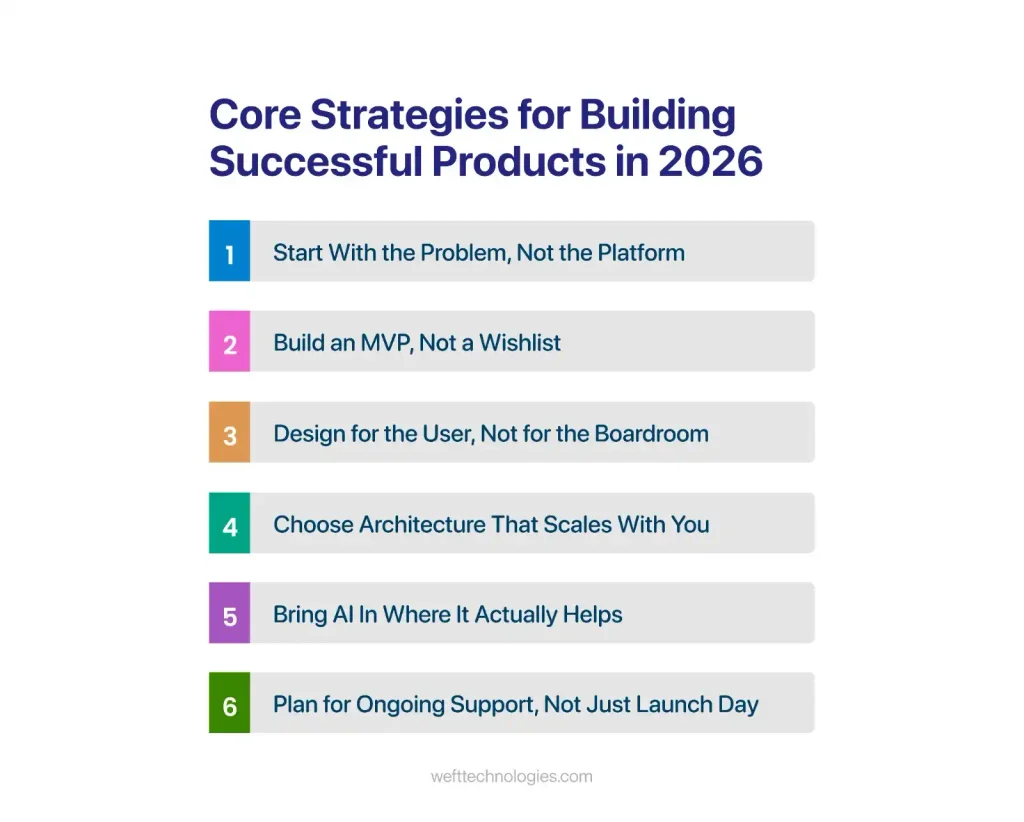
Building a successful digital product in 2026 requires more than strong technology. Businesses need a clear strategy that connects user needs, business goals, technology, and continuous improvement. The following strategies can help teams build products that are valuable, scalable, secure, and ready for long-term growth.
1. Start With the Problem, Not the Platform
Too many product ideas fail because teams jump straight to building an app without validating whether the problem is worth solving. Before writing a single line of code, spend real time on:
- Talking to potential users, not just assuming their needs
- Mapping the customer journey end to end
- Identifying the one core problem your product must solve exceptionally well
A product built around a validated problem has a far higher chance of adoption than one built around a feature list.
2. Build an MVP, Not a Wishlist
A Minimum Viable Product isn’t a simple version of your idea, it’s the smallest version that still delivers real value. This lets you:
- Get into the market faster
- Collect actual user feedback instead of assumptions
- Avoid spending months building features nobody uses
Weft Technologies typically works with clients to define a lean MVP scope first, then plan a clear roadmap for what comes after launch.
3. Design for the User, Not for the Boardroom
It’s tempting to design a product around internal opinions. But successful products are shaped by how real users behave. That means:
- Usability testing before and after launch
- Clean, intuitive interfaces over “feature-heavy” screens
- Accessibility and mobile-first design, since most UAE users engage on mobile first
4. Choose Architecture That Scales With You
One of the most common mistakes businesses make is building for today’s user base instead of tomorrow’s. A scalable digital product needs:
- Cloud architecture that scales automatically with user demand, reduces upfront infrastructure cost
- Modular system design that allows new features to be added without rebuilding the whole product
- API-first development that makes it easier to integrate with ERP, CRM, payment gateways, and third-party tools later
This is where experienced providers of IT services in Dubai add real value. They design systems that grow with the business instead of needing a costly rebuild two years later.
5. Bring AI In Where It Actually Helps
AI shouldn’t be added just to check a box. It works best when it solves a specific, measurable problem, like faster customer support, smarter recommendations, predictive maintenance, fraud detection, or automating repetitive internal workflows. Thoughtful Artificial Intelligence solutions and AI development work today are focused on precision, not novelty.
6. Treat Security as a Foundation, Not a Feature
Security needs to be built in from the architecture stage, not patched on afterward. This includes:
- Data encryption and secure authentication
- Regular vulnerability testing
- Compliance with UAE data protection regulations
- Clear access control across teams and systems
A single breach can undo years of customer trust, so this step is never optional.
7. Plan for Ongoing Support, Not Just Launch Day
Launch is the beginning, not the finish line. Products need continuous monitoring, updates, and improvements based on real usage data. This is why many UAE businesses now prefer working with a full-service partner offering managed IT services and IT consulting in Dubai, rather than juggling multiple vendors for development, hosting, and support separately.
Common Challenges Businesses Face and How to Avoid Them
| Challenge | Why it Happens | How to Avoid It |
|---|---|---|
| Scope creep | No clear MVP definition upfront | Lock a defined MVP scope before development starts |
| Slow time-to-market | Trying to build everything at once | Launch in phases, iterate based on real feedback |
| Poor adoption | Product built without user research | Validate the problem before building the solution |
| Security gaps | Security treated as a final step | Build security into the architecture from day one |
| Scaling issues | Infrastructure not designed for growth | Choose cloud-based, modular architecture early |
Why Businesses Choose to Partner With an Experienced Technology Provider
Building in-house from scratch can work for some businesses, but many find that partnering with an established technology solutions in Dubai provider gets them to market faster and with fewer costly mistakes. A good partner brings:
- Proven frameworks instead of trial-and-error development
- Access to specialised talent across design, engineering, AI, and security
- Faster delivery timelines backed by real project experience
- Ongoing support after launch, not just a handover and goodbye
This is the difference between hiring developers and partnering with a digital transformation company in UAE businesses can rely on long-term.
Choosing the Right Development Partner in Dubai
When evaluating an IT company in Dubai for your product build, look beyond price. Ask:
- Can they show real, relevant case studies, not just a portfolio of logos?
- Do they offer end-to-end support: strategy, design, development, security, and maintenance?
- Are they transparent about timelines and costs from the start?
- Do they understand your industry’s specific compliance and operational needs?
- Will you have a dedicated point of contact, or get passed between teams?
The right partner should feel less like a vendor and more like an extension of your own team.
Build It Right, Not Just Fast
2026 is rewarding businesses that build thoughtfully, validating ideas early, designing for real users, planning for scale, and treating security and support as part of the product, not an afterthought. Whether you’re building your first digital product or scaling an existing one, the right strategy and the right partner make all the difference.
At Weft Technologies, we help businesses across Dubai and the UAE turn ideas into secure, scalable, and genuinely useful digital products, from initial strategy through to long-term support. If you’re planning your next product and want a partner who treats it like their own, get in touch with Weft Technologies today and let’s talk about what you’re building.