

Building an MVP is an important milestone, but it does not mean a SaaS product is ready to scale. The real test begins when UAE customers start using it. For founders, the next question is simple: does the product solve a problem people genuinely care about, and are they willing to keep using and paying for it?
For product-market fit for SaaS startups in the UAE, the answer cannot come from assumptions or a few positive conversations. It comes from customer behaviour, retention, repeated usage, willingness to pay, and measurable business value. This is where SaaS market validation becomes critical.
As a SaaS development company in UAE that founders lean on at exactly this stage, we’ve watched teams pour budget into growth too early, only to realise the product wasn’t quite right yet. This guide walks through how to know the difference before you spend a single dirham on scaling. Here you will get the detailed answer for how UAE SaaS founders can move from an MVP to real market validation, identify meaningful product-market-fit signals, and decide whether it is time to improve, pivot, or scale.
What Product-Market Fit Actually Means
Product-market fit is the point where a defined group of customers consistently uses your product, keeps paying for it, and would be genuinely upset if it disappeared.
- True product-market fit is reflected in customers who keep using and paying for a product, not simply in the number of signups or downloads.
- After launch, a SaaS MVP acts as a real-world testing ground where founders can validate demand and learn what customers actually need.
- High signups can sometimes hide weak product-market fit, especially when users rarely return and customer churn remains high.
A SaaS product is moving toward product-market fit when:
- Target customers have a clear, recurring problem.
- Users regularly return to the product.
- Customers achieve a measurable outcome from using it.
- Users are willing to pay for the solution.
- Retention improves as the product gets better.
- Existing customers recommend or introduce others to the product.
This distinction matters because an MVP can attract early users without solving a problem strongly enough to support long-term growth.
Getting this definition right matters because it’s easy to look busy with new users, press mentions, and demo requests without actually having SaaS product-market fit.
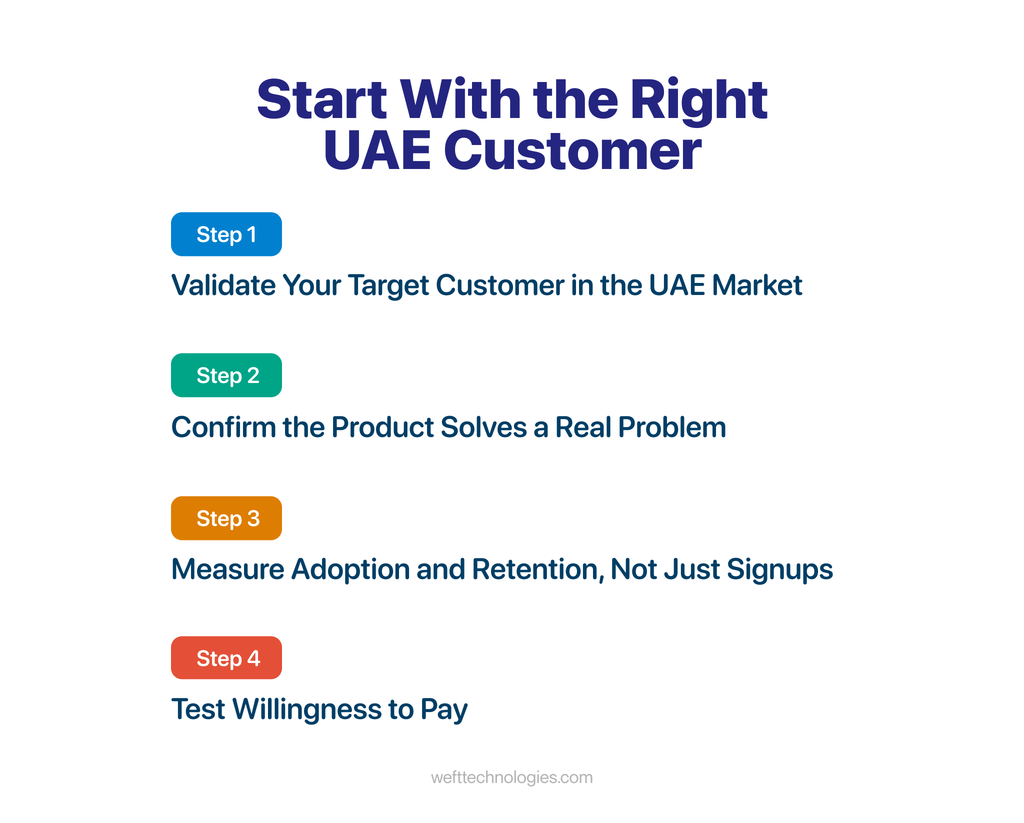
Start With the Right UAE Customer
Before measuring product-market fit, founders need to be certain that they are testing the product with the right customers.
The UAE is not a single customer segment. A SaaS product aimed at a logistics company may have very different requirements from one designed for a healthcare provider, property business, retailer, or professional services company. Even within the same industry, company size, decision-making structures, budgets, and operational needs can vary.
Here are the steps to follow:
Step 1: Validate Your Target Customer in the UAE Market
Before checking whether the product works, check whether you’re talking to the right people. Many UAE SaaS startups build for a broad audience and only later discover their real buyer looks nothing like the initial assumption.
- Identify who is actually converting and staying, not who you originally designed the product for
- Pay attention to company size, industry, and decision-maker role, UAE B2B buyers often involve more than one stakeholder in a purchase decision
- Separate users who tried the product out of curiosity from those solving a genuine daily problem with it
If your early customers keep coming from one specific industry or company type, that is often a stronger signal than a widespread group of casual users.
Step 2: Confirm the Product Solves a Real Problem
This sounds obvious, but it’s the step most founders skip once they’re excited about early traction. Real SaaS product validation means checking:
- Do users come back to solve the same problem repeatedly, or was it a one-time use case?
- Can users clearly explain, in their own words, what the product does for them?
- Would they be frustrated, not just mildly annoyed, if the product stopped working tomorrow?
If the answer to that third question is a shrug, the product hasn’t earned its place in the user’s workflow yet.
Step 3: Measure Adoption and Retention, Not Just Signups
Signups are the easiest metric to celebrate and the least useful one for judging fit. What actually matters for SaaS market validation is what happens after someone signs up:
- Activation rate – how many new users actually reach the “aha moment” where the product proves its value
- Retention curve – whether usage stays steady after week one, or drops off sharply
- Feature usage depth – whether users engage with the core value feature, or just poke around the edges
A product with modest signups but strong week-four retention is usually in a healthier place than one with big signup numbers and a steep drop-off.
Step 4: Test Willingness to Pay
Interest is cheap. Payment is proof. Testing willingness to pay in the UAE market comes with a few local realities worth planning around:
- UAE B2B buyers often expect a demo or trial period before committing, more than a pure self-serve signup
- Pricing conversations frequently involve procurement or finance stakeholders, not just the end user
- Annual contracts and invoicing preferences are common in UAE B2B SaaS, alongside monthly plans
If prospects are willing to negotiate terms, ask about invoicing, or push back on price rather than walking away entirely, that pushback itself is often a sign they see real value.
Signals That Tell You’ve Found Product-Market Fit
| Signal | What It Looks Like |
| Strong retention | Users are still active weeks or months after signup |
| Organic referrals | New users arrive through word of mouth, not just marketing spend |
| Willingness to pay | Prospects negotiate terms instead of disappearing after pricing |
| Clear use case | Users describe the product’s value in their own simple words |
| Consistent customer profile | Repeat pattern in industry, company size, or role of paying users |
Signals That Tell You Haven’t (Yet)
| Signal | What It Looks Like |
| High churn | Users try it once and never return |
| Vague feedback | “It’s nice” instead of “I use this every day for X” |
| Price sensitivity without negotiation | Prospects simply vanish when pricing comes up |
| Scattered customer base | No clear pattern in who’s actually sticking around |
Neither list needs to be perfect. But if most of your signals sit in the second table, that’s useful information, not a failure.
Decision Point: Iterate, Pivot, or Scale
Once you’ve gathered real usage, retention, and payment data, there are only three honest paths forward:
- Iterate: The core idea is right, but onboarding, features, or messaging need work before it clicks with more users
- Pivot: The current customer segment or use case isn’t showing fit, and the product needs to shift toward a different problem or audience
- Scale: Retention, referrals, and payment signals are consistently strong, and it’s time to invest in growth
Choosing to scale before these signals are genuinely strong is one of the most expensive mistakes in SaaS startup growth, it multiplies acquisition spend on a product that isn’t ready to hold onto the customers it wins.
Looking Beyond the UAE: GCC Expansion
Once product-market fit is confirmed locally, many founders look toward Saudi Arabia, Qatar, and the wider GCC as a natural next step. The good news is that a product validated with real UAE customers, proven problem, proven retention, proven willingness to pay, travels far better across the region than one that’s only been tested on assumptions. The SaaS MVP to market journey doesn’t end at product-market fit; it simply gives you a much stronger foundation before expanding further.
Finding real product-market fit for SaaS startups in UAE isn’t about moving fast, it’s about checking, honestly, whether the right customers are staying, paying, and telling others. Get that right first, and scaling becomes a much safer bet.
At Weft Technologies, a SaaS development company in UAE, we work with UAE SaaS founders through this exact stage, helping teams read their product’s real signals and decide what comes next with confidence. If you’re trying to figure out whether your MVP is ready to scale, get in touch with Weft Technologies, and let’s look at your numbers together.