

Generative AI is changing how enterprises work, serve customers, manage information, and build digital products. From creating business documents and analyzing data to assisting employees and automating complex workflows, generative AI for business transformation is moving from experimentation into practical enterprise use.
For large organizations, however, adopting AI is not simply about adding a chatbot or purchasing an AI tool. The real opportunity lies in connecting AI with business processes, enterprise applications, data, and customer experiences. When implemented strategically, generative AI can become an important part of enterprise digital transformation, helping organizations improve efficiency while creating new ways to deliver value.
What Is Generative AI for Business Transformation?
Generative AI refers to artificial intelligence systems that can create new content such as text, code, summaries, images, or other outputs based on information and instructions provided to them.
In an enterprise environment, its role goes beyond content generation. Generative AI can help employees find information, summarize large volumes of documents, assist with software development, analyze business data, and automate parts of customer and operational workflows.
The important distinction is that enterprise AI should be connected to a clearly defined business problem.
Enterprise AI transformation combines AI capabilities, business processes, enterprise data, and measurable business outcomes to drive meaningful change.
For example, a company may use generative AI to summarize customer interactions, identify common service issues, and help support teams respond faster. The value does not come from generating text alone; it comes from improving the customer service process.
Why Generative AI Is Becoming Important for Enterprise Digital Transformation
Traditional digital transformation focused heavily on moving processes from manual or paper-based systems to digital platforms. Generative AI takes this further by helping systems understand information, generate responses, identify patterns, and support decisions.
Several factors are increasing its importance for enterprises:
- Large volumes of data: Enterprises have vast amounts of documents, customer records, emails, reports, and operational information that can be difficult to process manually.
- Pressure to improve productivity: AI business process automation can reduce repetitive work and allow employees to focus on higher-value activities.
- Higher customer expectations: Customers increasingly expect faster, personalized, and convenient digital experiences.
- Legacy technology challenges: AI can become part of broader modernization initiatives when organizations need to improve older applications and workflows.
- Faster decision-making: AI can help employees extract useful information from large datasets and documents more quickly.
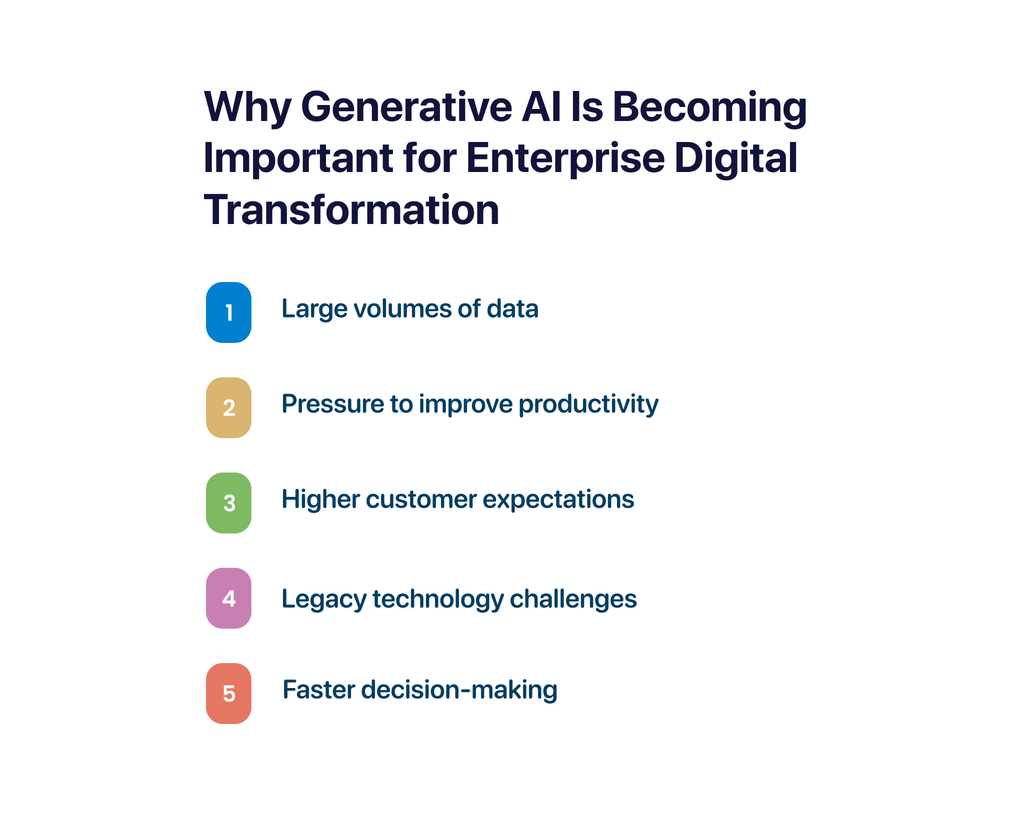
Generative AI can accelerate enterprise processes by improving access to information, reducing repetitive work, and helping teams complete tasks faster. Its business value is strongest when it is applied to processes where delays, manual effort, or limited access to information are affecting performance.
Key Generative AI Use Cases for Enterprises
Generative AI can be applied across departments, but enterprises should prioritize use cases based on business value rather than simply adopting AI because it is trending.
AI-Powered Customer Experience
Customer service is one of the most visible applications of generative AI. AI assistants can understand customer questions, retrieve relevant information, summarize conversations, and help service teams provide faster responses.
Enterprises can use AI to support:
- Customer service assistants
- Personalized recommendations
- Automated responses
- Knowledge-base search
- Conversation summaries
- Customer feedback analysis
The goal is not necessarily to remove human interaction. In many cases, AI can handle routine requests while employees focus on complex customer issues.
Intelligent Document Processing
Enterprises deal with contracts, invoices, applications, reports, forms, and other documents every day. Reviewing and extracting information from these documents manually can consume significant employee time.
Generative AI can help summarize documents, extract relevant information, classify content, compare documents, and make information easier to search.
Enterprise documents often contain large volumes of information that can be difficult to process manually. Generative AI can assist with organizing and processing this information, reducing manual effort and making important business data easier for employees to access.
AI Business Process Automation
Traditional automation generally follows predefined rules. Generative AI can make certain workflows more flexible by helping systems interpret natural-language requests and work with less-structured information.
Potential applications include:
- Generating reports
- Processing internal requests
- Creating summaries
- Routing tasks
- Drafting business communications
- Supporting workflow decisions
The best results often come from combining traditional automation with AI rather than replacing every existing automation system.
Data Analysis and Decision Support
Enterprise leaders often have access to more data than they can realistically review manually. Generative AI can provide natural-language interfaces that allow employees to ask questions about business information and receive easier-to-understand summaries.
For example, a manager could ask an internal AI system to summarize sales performance, identify unusual changes, or highlight areas that require attention.
However, AI-generated insights should be validated against trusted enterprise data, particularly when decisions involve financial, legal, operational, or customer-sensitive information.
Software Development
Generative AI is also changing enterprise software engineering. Development teams can use AI to assist with code generation, documentation, testing, debugging, and understanding existing codebases.
For organizations investing in enterprise software development in Dubai, this can help development teams accelerate repetitive engineering tasks while allowing experienced developers to focus on architecture, security, and business requirements.
AI should support engineering teams rather than replace engineering judgment. Code still needs appropriate review, testing, security checks, and governance.
Employee Productivity
Generative AI can act as an assistant across everyday enterprise work. Employees can use approved AI systems to summarize meetings, draft documents, search internal knowledge, prepare reports, and organize information.
The productivity benefit becomes more significant when AI is securely connected to the information employees already need to do their jobs.
Generative AI and Legacy Modernization
Legacy systems remain a major challenge for many enterprises. Older applications may support critical business operations but can be difficult to maintain, integrate, or update.
Legacy modernization does not always mean replacing an entire system immediately. Enterprises can take a gradual approach by identifying valuable processes, modernizing interfaces, exposing functionality through APIs, and introducing AI where it provides measurable value.
Generative AI can assist modernization by helping teams understand older code, generate documentation, identify dependencies, and support the migration process.
A practical approach is to assess existing systems, prioritize critical areas, integrate AI where it adds value, modernize in phases, test thoroughly, and then scale. This helps enterprises modernize legacy systems while minimizing disruption to ongoing business operations.
How Generative AI Fits Into an Enterprise Digital Transformation Strategy
AI should not operate as a separate technology experiment. It should fit into the organization’s wider transformation strategy.
A practical enterprise digital transformation strategy can follow these steps:
1. Identify Business Problems- Start with processes that are costly, repetitive, slow, or difficult to scale.
2. Prioritize AI Opportunities- Evaluate potential use cases based on business value, technical feasibility, data availability, and risk.
3. Prepare Enterprise Data- AI applications depend heavily on the quality, accessibility, and governance of the data they use.
4. Build a Controlled Pilot- Start with a focused use case rather than attempting an enterprise-wide AI rollout immediately.
5. Measure the Outcome- Track improvements in productivity, processing time, customer satisfaction, cost, accuracy, or revenue.
6. Integrate and Scale- Once a use case demonstrates value, connect it with enterprise systems and gradually expand its use.
This approach helps organizations move from AI experimentation toward practical AI-driven digital transformation.
Challenges Enterprises Must Address
Generative AI can create significant value, but enterprise adoption also introduces risks that cannot be ignored.
Data Security and Privacy
Enterprise AI systems may process sensitive customer, financial, employee, or operational information. Organizations need clear policies around what data can be used, where it is processed, and who can access it.
AI Governance
Organizations need controls for responsible AI usage, including access policies, human oversight, monitoring, and processes for handling incorrect or inappropriate outputs.
Integration Complexity
AI solutions must often work with ERP, CRM, databases, document systems, and other enterprise applications. Poor integration can limit the value of an AI initiative.
Accuracy and Human Oversight
Generative AI can produce incorrect or misleading information. High-impact business processes therefore require appropriate validation and human oversight.
Scalability and Cost
An AI solution that works for a small pilot may require different infrastructure and cost controls when deployed across thousands of employees or large customer volumes.
Employee Adoption
Technology alone does not create transformation. Employees need training, clear usage guidelines, and an understanding of how AI fits into their existing roles.
Enterprise AI creates sustainable business value when its adoption is properly governed. This means addressing security, data quality, system integration, and human oversight alongside the implementation of AI solutions.
How to Measure the ROI of Generative AI
AI investment should be connected to measurable business outcomes rather than the number of AI tools deployed.
Depending on the use case, enterprises can measure:
| Area | Possible KPI |
| Productivity | Hours saved per employee |
| Customer service | Response and resolution time |
| Automation | Percentage of tasks automated |
| Operations | Processing time and operating cost |
| Customer experience | Satisfaction and engagement |
| Software development | Development and testing efficiency |
| Decision support | Time required to access business insights |
| Financial impact | Cost savings or additional revenue |
The right KPI depends on the business problem. A customer-service AI system may be measured through response time and customer satisfaction, while document automation may be measured through processing time and manual effort saved.
A Practical Roadmap for Enterprise AI Transformation
Enterprises do not need to transform every process at once. A phased approach can reduce risk and make investment easier to justify.
Phase 1 – Discover: Identify high-value business problems and potential AI use cases.
Phase 2 – Assess: Evaluate data, security, integration requirements, technical feasibility, and expected ROI.
Phase 3 – Pilot: Build a controlled AI solution for a clearly defined business process.
Phase 4 – Validate: Measure performance, user adoption, accuracy, cost, and business outcomes.
Phase 5 – Integrate: Connect the validated solution with relevant enterprise systems and workflows.
Phase 6 – Scale: Expand successful AI applications across departments, locations, or customer channels.
This approach keeps AI transformation focused on business outcomes instead of technology adoption alone.
Why Enterprises Need the Right Technology Partner
Successful enterprise AI transformation requires a combination of business understanding, software engineering, data expertise, cloud infrastructure, security, and AI capabilities.
A capable digital transformation company in UAE enterprises should be able to look beyond individual AI tools and understand how technology fits into the organization’s broader architecture.
The right partner should help enterprises:
- Identify practical AI opportunities
- Modernize existing applications
- Integrate AI with enterprise systems
- Build secure AI solutions
- Improve customer and employee experiences
- Develop scalable software platforms
- Measure business outcomes
- Continuously improve AI solutions
This integrated approach is particularly important for organizations that need both enterprise software development in Dubai expertise and AI capabilities.
Why Weft for Enterprise Digital Transformation?
Weft helps businesses approach digital transformation as a business and product challenge, not simply a technology upgrade.
From product engineering and custom software development to AI, cloud, UX, and modernization, Weft brings multiple capabilities together to help enterprises create connected digital solutions.
Whether the goal is to modernize a legacy application, automate a business process, improve customer experience, or introduce AI into an existing enterprise environment, the focus remains on building solutions that create measurable value.
As businesses across the UAE move toward more intelligent and connected operations, Weft can support that journey with practical enterprise AI solutions, modern engineering practices, and scalable digital transformation capabilities.
Generative AI is becoming an important part of modern enterprise digital transformation, but its value does not come from AI adoption alone. The real opportunity lies in applying it to meaningful business problems, reducing repetitive work, improving customer experiences, making information easier to use, modernizing legacy systems, and helping employees make better decisions.
For enterprises, the best starting point is not to ask, “Where can we use AI?” Instead, ask, “Which business problem can AI solve better, faster, or more intelligently?”
A focused approach can help organizations move from isolated AI experiments to sustainable transformation. With the right strategy, governance, technology, and implementation partner, generative AI can become a practical engine for enterprise growth.
If your organization is exploring AI-driven transformation, legacy modernization, or intelligent enterprise applications, Weft UAE can help you identify opportunities and turn them into scalable digital solutions.
Contact Weft UAE to discuss your enterprise transformation goals and discover where Generative AI can create real business value.