

Building a software product in today’s competitive market requires more than just standard functionality and a sleek user interface. As SaaS environments mature, decision-makers, CTOs, and product leaders are under increasing pressure to integrate artificial intelligence. However, blindly rushing to implement generative chatbots or surface-level widgets often leads to feature bloat, low user retention, and wasted capital.
For digital leaders evaluating modern SaaS product development, the true goal of artificial intelligence is not novel engagement; it is frictionless utility. The most effective AI features for SaaS blend into existing user habits, eliminating manual effort without forcing teams to overhaul their operations.
Whether you are scaling an enterprise B2B platform or partnering with a Saas development company Dubai, UAE, understanding which AI capabilities drive measurable bottom-line value—and which simply create noise—is critical for sustainable product growth.
The Shift from Fluff to Frictionless AI Utility
In the early rush of generative tech, adding an AI label was often enough to generate temporary market interest. Today, B2B buyers and product managers recognize that superficial implementations rarely survive long-term budget reviews.High-value AI does not ask users to become prompt engineers or abandon their daily routines. Instead, it offers intelligent workflow automation that operates invisibly behind the scenes. When evaluating potential features, successful product teams focus on frictionless integration:
- In-Context Execution: AI capabilities should exist exactly where the user is already making decisions (e.g., inside an invoice screen, a CRM entry, or a logistics dispatch board).
- Zero-Learning Curve: The user receives a pre-calculated suggestion, automated draft, or flagged risk rather than a blank chat prompt.
- Measurable ROI: The feature directly reduces operational overhead, minimizes costly human error, or speeds up transaction times.
Core AI Features That Drive Genuine SaaS Value
When determining where to allocate product engineering resources, certain functional areas consistently yield high user retention and strong commercial return.
1. Intelligent Workflow & Task Automation
Repetitive data entry, unstructured document parsing, and multi-tier approval chains consume thousands of productive hours each year. Embedding AI workflow automation into everyday routines converts static software into proactive operational partners.
Rather than requiring users to manually advance tasks through sequential stages, AI-powered automation parses incoming documents, classifies content, updates backend records, and routes items for sign-off.
- Practical Example: An ERP system automatically reads unstructured PDF purchase orders, matches them against inventory levels, highlights supply chain risks, and drafts the purchase order without requiring manual copy-pasting.
2. Real-Time Anomaly Detection & Risk Mitigation
Data volume across modern enterprise platforms is growing too quickly for manual audits. One of the most vital AI in SaaS applications is real-time pattern recognition to catch mistakes before they compound.
By continuously monitoring operational data streams, background machine learning models establish normal baseline behavior and immediately flag irregularities.
- Financial & ERP Systems: Catching duplicate payments, vendor bank detail changes, or unexpected payroll spikes.
- Logistics & Supply Chain: Predicting shipment delays, warehouse bottlenecks, or inventory variance based on historical trends.
- Access Control & Compliance: Spotting abnormal user login locations or massive database export attempts.
3. Adaptive, AI-Assisted User Onboarding
Enterprise platforms frequently suffer from user churn due to steep onboarding curves. Feature-rich SaaS tools with dozens of sub-modules often confuse new hires, leading to low platform adoption.
Enhancing SaaS user experience through adaptive AI significantly reduces time-to-value. Instead of generic walkthrough popups or static documentation, adaptive onboarding customizes the user interface based on the user’s specific role and early behavior:
- Contextual Prompting: Highlighting the exact next step needed to complete setup tasks based on real-time activity.
- Dynamic Role Profiling: Automatically hiding non-essential configuration panels for operational staff while surfacing high-level analytical tools for executive users.
- Natural Language Assistance: Empowering users to complete complex system configurations using natural phrasing (e.g., “Configure tax rules for free-zone entities”).
4. Decision Support & Prescriptive Analytics
Standard SaaS dashboards show historical data , what happened yesterday or last month. High-value SaaS products leverage AI to move beyond static reporting toward prescriptive guidance.
Prescriptive models process contextual data to tell decision makers what action to take next, removing analytical friction.
- Sales Platforms: Suggesting the best time to follow up, preferred outreach channels, and custom discount limits to close target accounts based on past win patterns.
- HR & Workforce Systems: Flagging team retention risks and suggesting workload reallocations before burnout impacts delivery schedules.
5. Controlled Workflow Automation (Human-in-the-Loop)
A frequent point of failure when launching AI solutions for businesses in UAE environments is over-automating without administrative oversight. Enterprise stakeholders in regulated sectors such as finance, healthcare, legal, and real estate are reluctant to grant total autonomy to unmonitored systems.
By embedding “Human-in-the-Loop” checkpoints into intelligent workflow automation, product teams deliver the speed of machine intelligence coupled with robust governance controls:
- Confidence Scoring: The AI assigns a confidence score to each generated action. If the score falls below a defined threshold (e.g., 95%), the item is routed to a team lead for a single-click review.
- Audit Logs: Every automated decision and manual adjustment is logged in an immutable audit trail for compliance verification.
Identifying Low-Value AI Features to Avoid
To stretch product engineering budgets, founders and product teams must be willing to prune low-value features. Building low-adoption tools inflates technical debt and distracts from core value drivers.
When shaping your roadmap, evaluate these low-impact capabilities critically:
- Standalone Chat Widgets: Forcing users to write open-ended prompts into a side drawer when a well-placed button or automatic trigger accomplishes the task faster.
- Basic Text Summarizers: Simple “Summarize this page” buttons offer little differentiation and are already built natively into modern browsers and operating systems.
- Uncontextualized Text Generators: Standard text generation lacking integration with internal workspace records, sales history, or domain rules creates generic copy that users end up rewriting manually.
Build vs. embed: the Integration Decision
The Build vs. Embed integration decision centers on whether a SaaS product team should write custom native integrations in-house or leverage an embedded Integration Platform as a Service (ePaaS), unified API layer, or third-party service.
Key Trade-Offs
| Decision Criteria | Build In-House | Embed Third-Party |
| Time to Market | 6–18 months for multi-connector scaling | 4–8 weeks to production readiness |
| Engineering Focus | Diverts core product teams to write infrastructure glue | Preserves internal resources for primary core features |
| Maintenance & Debt | High ongoing tax (API updates, versioning, edge cases) | Outsourced to vendor, manageable via vendor SDK updates |
| Customization & Depth | Unlimited control over business logic & custom data schemas | Constrained by vendor API coverage & standard object mappings |
| Unit Economics | High initial CapEx (developer salaries) | Predictable OpEx (subscription/usage-based platform fees) |
Evaluation Criteria
Choose Build In-House When:
- Core Differentiator: The integration contains proprietary algorithm pipelines, unique business IP, or custom data structures central to your competitive advantage.
- Low Connector Variety: You only need deep, highly complex connections to 1–2 specific enterprise platforms (e.g., custom legacy ERPs).
- Strict Security Boundaries: Data cannot cross external intermediate proxies, or regulatory mandates require end-to-end data residency under direct control.
Choose Embed When:
- Scale & Breadth: Your product roadmap requires supporting dozens of common CRMs, ERPs, accounting, or support tools to win deal pipeline.
- Speed to Market: Competitive threats or customer churn demand rapid integration deployment within weeks rather than months.
- Resource Preservation: Your engineering team is small or needs to remain focused entirely on core product features.
Regional Integration: Enterprise Expectations in the UAE Market
For teams partnering with a SaaS product development agency Dubai or shipping software across the Middle East, local enterprise expectations heavily influence feature adoption.
The market is undergoing rapid digital growth, backed by ambitious national transformation agendas and international corporate investments. As a result, AI technology in UAE enterprise environments must satisfy distinct requirements:
- Data Sovereignty & Privacy: Enterprise decision-makers demand uncompromising data protection. SaaS products serving the market must support local hosting options, isolated tenant environments, and strict policies preventing customer data from training public base models.
- Multi-System Interoperability: UAE enterprises routinely run hybrid technology environments, mixing legacy ERP systems with modern cloud applications. AI capabilities must connect through robust APIs into existing infrastructure without demanding full system overhauls.
- Native Bilingual Capabilities: High-impact SaaS products must go beyond literal word translations, offering contextual processing across both Arabic and English contracts, official documentation, and operational logs.
Navigating these real-world requirements ensures that AI adoption in UAE business landscapes successfully transitions from early proofs-of-concept to organization-wide rollouts.
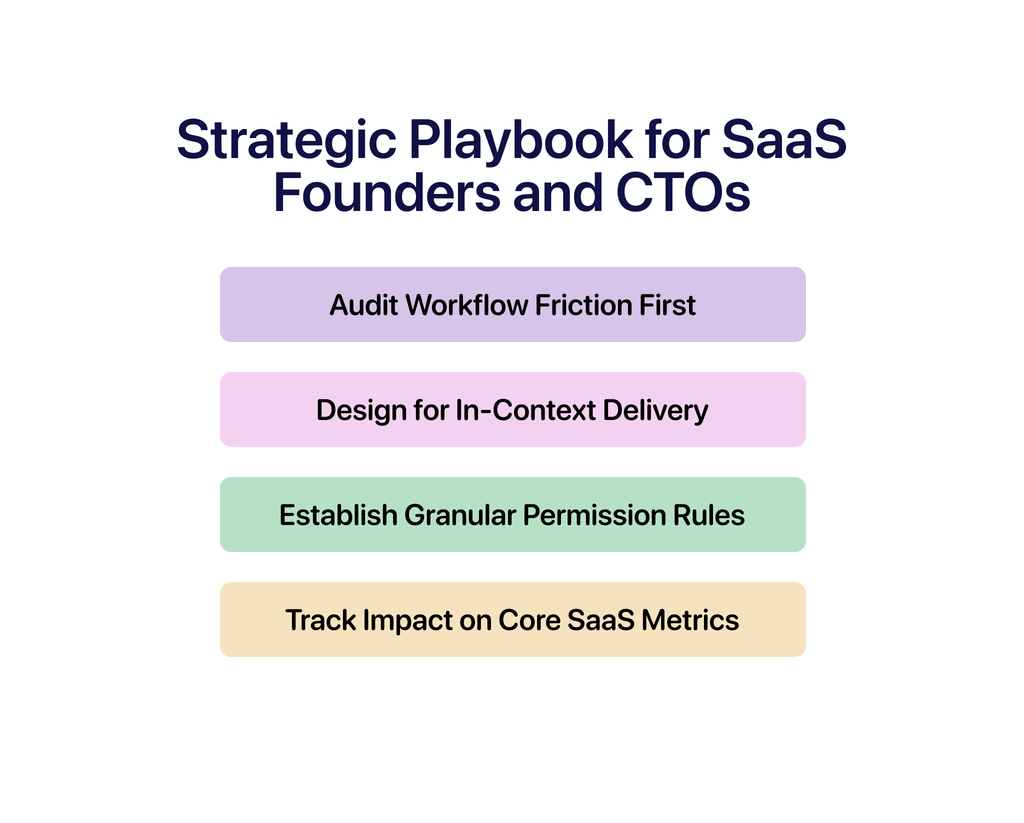
Strategic Playbook for SaaS Founders and CTOs
If you are structuring your product roadmap or coordinating with a Saas development company Dubai,UAE or professional saas development services Dubai, use this step-by-step approach to prioritize AI functionality:
- Audit Workflow Friction First: Map out where your existing users spend the most manual effort or experience onboarding drop-off. Build AI capabilities tailored specifically to remove those bottlenecks.
- Design for In-Context Delivery: Integrate AI recommendations directly into primary screens. Avoid forcing users to open external windows or alter their standard operational flows.
- Establish Granular Permission Rules: Give enterprise administrators full control over automated execution thresholds, team permissions, and review requirements.
- Track Impact on Core SaaS Metrics: Evaluate feature performance using clear operational indicators such as decreased task completion times, faster onboarding completion, reduced user churn, and higher feature retention rather than simple UI click rates.
Building Purpose-Driven Software
The true ROI of artificial intelligence in modern software products comes from quiet, reliable utility rather than temporary novelty.
By focusing on controlled workflow automation, predictive decision support, adaptive onboarding, and strict enterprise security, SaaS founders and technical leaders can build platforms that deliver immediate, defensible value.
Collaborating with a skilled SaaS product development agency, Dubai or an established product engineering team ensures your roadmap stays focused on high-impact functionality. Focus on solving real operational problems, and your platform will stand out as an essential driver of enterprise efficiency.
Whether you are launching a new product from scratch or upgrading an enterprise platform, our team delivers software solutions that streamline workflows, protect user data, and maximize long-term retention.