

The United Arab Emirates has established itself as the premier innovation and startup hub of the Middle East. Backed by government initiatives like Dubai’s D33 Agenda, Abu Dhabi’s Hub71, tax-efficient free zones, and a digitally native population, the region offers fertile ground for visionary entrepreneurs.
However, many non-technical founders face a critical barrier: How do you turn a business concept into a functional software product without writing code, overspending, or taking unnecessary risks?
Building a Minimum Viable Product (MVP) with an experienced MVP Development Company in UAE is not about releasing a broken or incomplete application. It is about deploying a focused, functional version of your product containing the core features necessary to solve a specific problem, validate demand in the UAE market, and collect real-time user feedback. This guide outlines how non-tech founders can plan, build, and launch a scalable MVP for startups in Dubai and the wider UAE while preserving capital and protecting business equity.
What Is an MVP and Why Is It Critical for UAE Startups?
MVP in business stands for Minimum Viable Product: the smallest usable version of a product or service that solves one important customer problem and lets you test whether people actually want it. For any startup MVP UAE founders, this approach serves as the foundation for startup idea validation and product-market fit.
For a non-technical founder, an MVP is primarily a strategic risk-mitigation tool. Instead of spending months building a full-fledged platform that may fail to resonate with users, an MVP allows you to test your core business hypothesis in the real world with minimal investment. It is to learn quickly using real customer behavior and feedback before committing major time, money, and development resources to a full solution. An MVP typically has only the essential features needed for early users to gain value.
The three parts
| Term | What it means |
| Minimum | Include only what is necessary to test the core idea; exclude nice-to-have features |
| Viable | It must genuinely work well enough to solve a customer’s problem- not merely be a concept or broken demo |
| Product | It can be software, a physical product, or even a manual service delivered behind a simple interface |
Strategic Benefits of MVP Development
- Reduced Financial Risk: Developing a complete digital platform without validation exposes founders to high costs. An MVP keeps development costs manageable while testing commercial viability.
- Faster Time-to-Market: Traditional software builds can take a long time to ship. A streamlined MVP development process typically takes 8 to 16 weeks to launch in the UAE market.
- Early Investor Attraction: Regional angel networks and venture capitalists in Dubai look for customer interest and proven traction. Demonstrating early user sign-ups and revenue through an MVP strengthens founder-investor trust.
- Real-World User Feedback: Gathering instant feedback from local users helps founders identify which features should be developed next based on actual needs rather than assumptions.
Defining Scope: Selecting the Right Features
One of the most frequent mistakes non-technical founders make is feature creep. To launch efficiently, you must separate core functionality from secondary enhancements.
Essential MVP Features vs. Future Scope
| Development Category | Feature Examples | Action for MVP Launch |
| User Registration & Onboarding | OTP Login, Social Authentication, Basic Profiles | Include in MVP |
| Core Product Functionality | Search & Filtering, Booking Workflow, Primary Problem Resolution | Include in MVP |
| Payment Integration | Apple Pay, Credit Card Gateway, Local Processing | Include in MVP |
| Admin & Operational Layer | Basic Admin Dashboard, Analytics Tracking | Include in MVP |
| Advanced Features | AI Engines, Loyalty Programs, Complex Recommendation Systems | Defer to Version 2.0 |
Choosing the Right Build Route as a Non-Tech Founder
Non-technical founders do not need to write code, but they must select the right execution model to build their product efficiently.
Option A: No-Code & Low-Code Platforms
- Best For: Simple directories, content platforms, basic marketplaces, and early workflow testing.
- Pros: Low financial cost and rapid setup times.
- Cons: Scalability limits, potential vendor lock-in, and constraints on custom API integrations.
Option B: Partnering with an MVP Development Company in UAE
- Best For: Custom web platforms, mobile apps, SaaS solutions, and complex transactional tools.
- Pros: Access to complete engineering teams offering specialized MVP development services Dubai (UI/UX designers, backend developers, QA testers), structured timelines, and scalable custom MVP development.
- Cons: Requires a higher initial financial commitment than self-built tools.
Option C: Onboarding a Technical Co-Founder
- Best For: Deep-tech, proprietary algorithms, and core artificial intelligence research.
- Pros: Dedicated technical leadership and long-term vision alignment.
- Cons: Highly competitive recruitment market; requires sharing significant equity early on.
Key UAE Regulatory, Cloud, and Payment Considerations
Launching a digital product in the UAE market requires adherence to regional business, technical, and regulatory standards.
- Data Privacy and Governance: Compliance with Federal Decree-Law No. 45 of 2021 (Protection of Personal Data) is essential. Applications handling sensitive user or financial data should utilize localized cloud providers, such as AWS Middle East (UAE) or Microsoft Azure UAE data centers.
- Localized Payment Gateways: UAE users expect seamless payment options. Integrate established regional payment gateway providers (such as Tap Payments, Telr, Network International, or Checkout.com) supporting debit/credit cards, Apple Pay, and local AED transactions.
- Bilingual UI/UX Design: The UAE is home to a diverse demographic. Depending on your audience segment, ensure your mobile or web app architecture supports clean toggling between Arabic and English interfaces.
Understanding MVP Development Cost UAE and Timelines
Establishing realistic expectations around budgets and timelines helps founders plan their runway effectively.Developing a custom startup MVP UAE product typically spans 8 to 16 weeks . This breakdown explains how these timelines are structured, what drives budget variations, and how to allocate capital efficiently.
Stage-by-Stage Breakdown of the 8–16 Week MVP Timeline
A structured MVP roadmap ensures that every phase from initial concept definition to app store deployment moves forward without unnecessary technical debt or feature bloat.
Weeks 1–2: Product Discovery, User Flow & Wireframing
- Objective: Translate the business vision into functional product requirement specifications.
- Key Activities: Conduct stakeholder workshops, define core user personas, map primary user journeys, and create low-fidelity wireframes.
- Business Outcome: Aligns team expectations on scope, preventing budget overruns caused by last-minute feature additions.
Weeks 3–4: UI/UX Interface Design & Architecture Setup
- Objective: Establish the visual identity and select scalable cloud infrastructure.
- Key Activities: Design high-fidelity interactive screens, establish design systems (tailored for English and Arabic bilingual requirements), and design database schemas.
- Business Outcome: Delivers clickable prototypes ready for early feedback from advisors, early adopters, or seed investors.
Weeks 5–12: Core Feature Frontend & Backend Development
- Objective: Build the functional core version of the application.
- Key Activities: Develop backend APIs, set up cloud database environments, construct frontend interfaces (web or cross-platform mobile via Flutter/React Native), and integrate localized UAE payment gateways (e.g., Tap Payments, Telr, or Checkout.com).
- Business Outcome: Delivers a fully operational product containing only essential workflows.
Weeks 13–14: Quality Assurance, Security & API Testing
- Objective: Ensure platform stability, security, and compliance before live traffic hits the system.
- Key Activities: Execute cross-browser/cross-device testing, conduct API integration stress testing, and run security checks to comply with UAE data protection standards
- Business Outcome: Prevents critical user-facing bugs that can ruin a product’s market reputation upon launch.
Weeks 15–16: Deployment, Store Submission & Market Launch
- Objective: Deploy the software to live production servers and mobile app stores.
- Key Activities: Configure cloud servers (e.g., AWS Middle East / Azure UAE data centers), submit mobile applications to the Apple App Store and Google Play Store, and establish live application monitoring.
- Business Outcome: Opens the platform to real users in Dubai and the wider UAE, initiating the post-launch feedback loop.
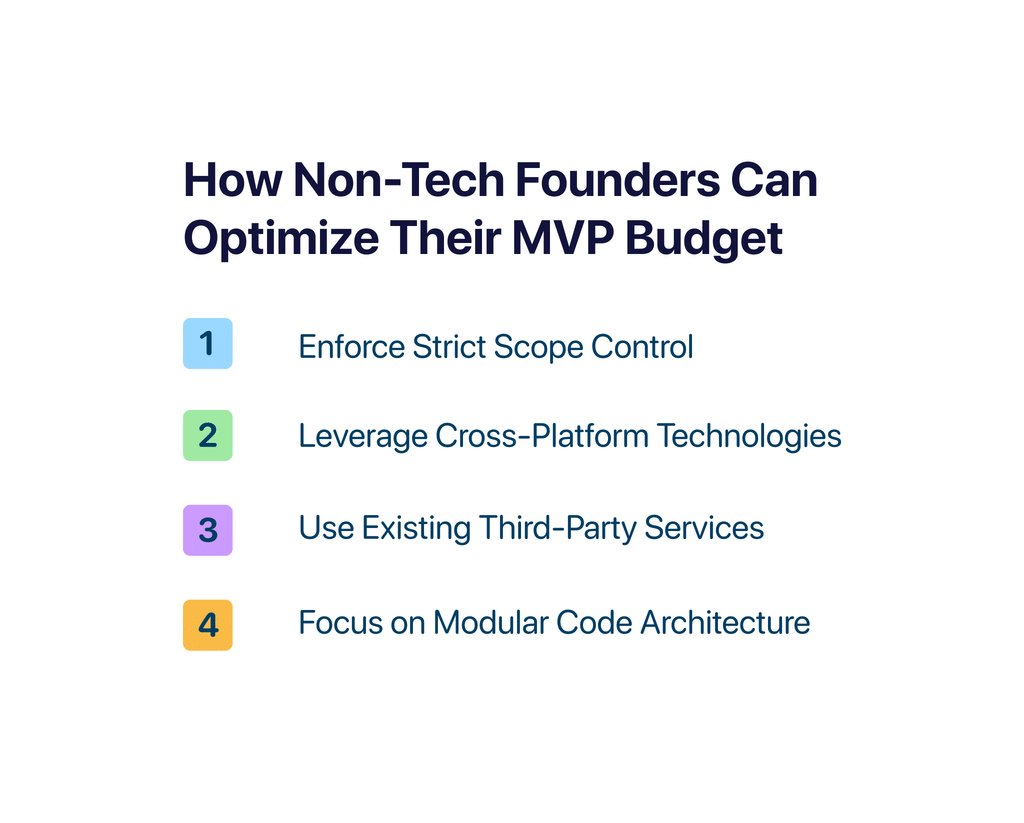
How Non-Tech Founders Can Optimize Their MVP Budget
To stay within the budget range and prevent project delays, non-technical founders should follow these cost-control practices:
- Enforce Strict Scope Control: Limit the initial launch strictly to features required to solve the primary user problem. Save secondary features (such as AI analytics, loyalty programs, or dark mode) for post-launch releases.
- Leverage Cross-Platform Technologies: Build cross-platform mobile apps to target both Apple and Android users in the UAE from a single codebase.
- Use Existing Third-Party Services: Instead of building custom infrastructure from scratch, leverage proven APIs for chat support, transactional emails, and cloud analytics.
- Focus on Modular Code Architecture: Ensure your MVP development partner builds clean, modular code that can scale into a full product as your user base and funding grow. Working with experienced teams skilled in Dubai startup development helps maintain quality standards while staying within budget.
Launch Your MVP with Confidence
Building an MVP as a non-technical founder in the UAE does not require coding expertise; it requires strategic focus, scope discipline, and the right technical execution partners. By focusing on a clear problem, selecting an efficient build route, complying with regional regulations, and iterating based on real user data, you can launch a software product positioned for long-term growth.
Ready to turn your business idea into a market-ready MVP? Consult our experts in MVP product development Dubai today to validate your concept, define your feature scope, and launch your software product in the UAE.