

Everyone wants to build “an AI product” these days. Fewer people stop to ask whether they actually need one, or what problem it’s solving. If you’re a founder in Dubai or anywhere else in the UAE thinking about your first AI MVP, the biggest mistakes usually happen before a single line of code is written. As a hands-on AI development company in Dubai that founders turn to when they’re at this exact stage, we’ve seen the same decision points come up again and again. This guide walks through what to settle before you start building.
What an AI MVP Actually Is
An AI MVP (Minimum Viable Product) is the smallest working version of your product that uses AI to solve one specific, validated problem, built to test real demand before you invest in a full-scale build. An AI MVP:
- AI MVP validates a business idea with real users before committing to full development
- It is treated as a smaller version of the full product instead of a focused test of one core assumption
- A successful AI MVP solves one problem well, uses only the data and features needed to prove that
Get this definition right early, and most of the decisions below become much easier.
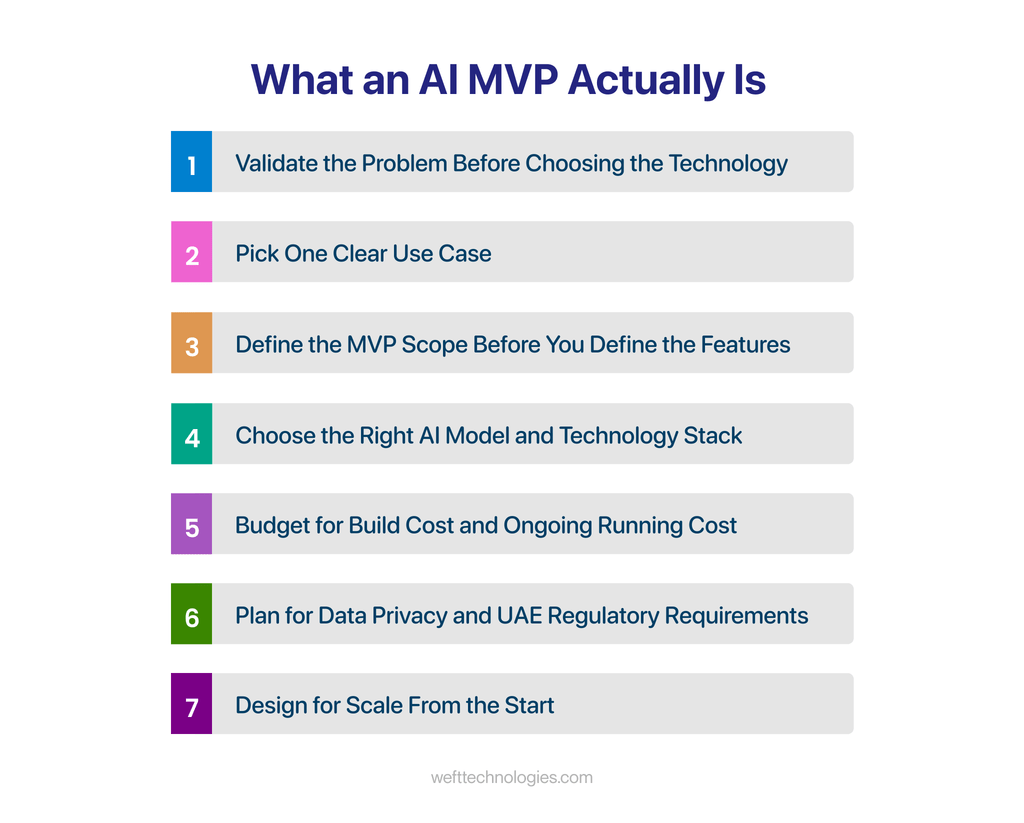
Decision 1: Validate the Problem Before Choosing the Technology
It’s tempting to start with “what can AI do here” instead of “what does the user actually need.” That order matters. Before touching a tech stack:
- Talk to real potential users about the specific problem, not the imagined solution
- Confirm the problem happens often enough, and is painful enough, that people will pay to fix it
- Resist the urge to design around impressive AI capabilities that don’t map to a real need
This is the core of AI product validation, and skipping it is the single biggest reason AI MVPs fail to find traction after launch.
Decision 2: Pick One Clear Use Case
AI can technically be applied to almost anything in a product, such as recommendations, chat support, forecasting, automation, and personalization. Trying to include several of these in a first release is a common trap. A focused AI MVP strategy means choosing the one use case that:
- Directly ties to a measurable business outcome (revenue, retention, cost savings, time saved)
- Can realistically be built and tested within a short timeframe
- Gives you a clean way to measure whether it actually worked
Everything else can wait for version two.
Decision 3: Define the MVP Scope Before You Define the Features
Once the use case is locked, the next decision is what belongs in the first release and what does not. This is where an AI MVP roadmap becomes useful, mapping out what launches now versus what gets added once the core idea is proven.
A tightly scoped AI MVP development plan typically includes:
- The single core AI-powered feature that tests your main assumption
- The minimum supporting features needed to make that feature usable
- Basic analytics to track whether users are getting value from it
Decision 4: Choose the Right AI Model and Technology Stack
This is usually where founders want to start and where they should start last. Once the use case and scope are clear, the right AI MVP architecture depends on questions like:
- Does this need a pre-trained model, or a model trained on your own data?
- Should this run on-premises, in the cloud, or through a third-party AI API?
- How much accuracy is genuinely required for an MVP, versus a polished, later-stage version?
- What’s the realistic AI MVP development timeline if you choose a custom-built model versus an existing one?
For most first releases, using proven AI APIs and frameworks is faster and cheaper than building a custom model from scratch. Custom models usually make sense once you have real usage data to train on.
Decision 5: Budget for Build Cost and Ongoing Running Cost
A lot of founders budget for development and forget that AI features often carry ongoing operational costs like API usage, compute, storage, and model retraining. When estimating AI MVP cost, plan for both:
| Cost Type | What It Covers |
| One-time build cost | Design, development, testing, integration, launch |
| Ongoing running cost | AI API usage, cloud hosting, data storage, monitoring |
| Maintenance cost | Bug fixes, model tuning, feature updates post-launch |
Underestimating the ongoing running cost is one of the most common budgeting mistakes we see with first-time AI builds.
Decision 6: Plan for Data Privacy and UAE Regulatory Requirements
Data handling shapes your architecture from day one. Businesses building an AI MVP in the UAE need to think through:
- Where user data is stored and processed, and whether that meets local data protection requirements
- What kind of user data the AI feature actually needs
- Whether the industry you’re in carries additional compliance requirements
- How consent and data usage will be communicated to users clearly
Working with an experienced AI solutions company in the UAE that businesses trust for this stage helps avoid rework later, when compliance gaps are far more expensive to fix.
Decision 7: Design for Scale From the Start
An MVP is meant to be minimal, but not to be impossible to grow. Before development starts, decide:
- Can this architecture handle 10x the users without a full rebuild?
- Is the AI MVP development process built on modular, cloud-based infrastructure?
- Will adding new features later require re-architecting, or just extending what’s already there?
A well-planned AI product development in the UAE means teams treat scalability as a day-one architecture decision, not a future problem.
Common Mistakes to Avoid in AI MVP Development
| Mistake | Why It Hurts | What to Do Instead |
| Building too many AI features at once | Slows launch, dilutes what you’re actually testing | Pick one core use case and prove it first |
| Choosing tech before validating the problem | Wastes budget on solving the wrong problem well | Validate demand, then choose the stack |
| Relying on AI capability instead of business need | Impressive tech, no clear ROI | Tie every feature to a measurable outcome |
| Ignoring ongoing running costs | Budget shock after launch | Plan for API, hosting, and retraining costs upfront |
| Skipping scalability planning | Costly rebuild once users grow | Choose modular, cloud-based architecture early |
Why Work With an Experienced AI Development Partner
Building an AI MVP touches product strategy, data science, engineering, security, and compliance, rarely all strengths inside one early-stage team. Partnering with a specialised provider of AI app development in UAE gives founders:
- A faster, more realistic path from idea to working MVP
- Guidance on which decisions actually matter now versus later
- Technical architecture built to scale without a costly rebuild
- A team that understands UAE market expectations and data requirements
The founders who succeed with AI MVPs aren’t the ones with the most advanced technology. They’re the ones who made the right decisions before development started: a validated problem, one clear use case, a tight scope, realistic costs, and an architecture built to grow.
As an AI development company in Dubai, at Weft Technologies, we help UAE founders and businesses work through exactly these decisions before writing a single line of code, then build AI MVPs designed to scale. If you’re planning your AI product and want to get these calls right from day one, get in touch with Weft Technologies, and let’s map out your next step.