

Most C-suite leaders in the UAE have already made up their minds about AI. The budget is provisionally earmarked. The board presentation has been drafted. Someone in the room has mentioned what a competitor is doing. The decision feels made.
And then the project starts. And six months later, quietly, it stalls. Not because the AI didn’t work. Because the organisation wasn’t ready for it. This is the conversation most AI vendors in Dubai don’t want to have with you. Because readiness is complicated, and complicated doesn’t close deals. But it’s the conversation that determines whether your AI investment delivers measurable value or becomes a cautionary story you don’t repeat at conferences.
This guide is for enterprise leaders in the UAE who are serious about AI, not just enthusiastic about it.
Is Your Enterprise AI Ready?
Many C-suite leaders are asking the same question right now: “Should we invest in AI?” However, that is the wrong question. The ship has sailed on whether AI is relevant to your business. It absolutely is. Your competitors are moving. The market is not waiting. The question that actually determines outcomes is this: “Are we ready to invest in AI in a way that won’t fail?”
AI readiness for UAE enterprises is not about having enthusiasm at the top. It’s not about budget. It’s not even about having the right vendor. It’s about whether your organisation has the foundational conditions that allow AI to do what it’s supposed to do. Most enterprises in this market do not have those conditions in place. Not because they’re behind but because nobody told them what those conditions actually look like.
AI readiness is not a checklist. It’s not a maturity score from a consulting framework. It’s an honest assessment of whether your organisation can absorb, operate, and improve an AI system after it’s been built. There are four dimensions to that assessment. Most enterprises are strong on one or two. Few are strong on all four.
1. Data Readiness
This is where nearly every enterprise AI adoption in the UAE hits its first wall, and it’s almost always a surprise.
The assumption going in is that data exists, so data isn’t a problem. The reality is that data is sitting in three different legacy systems. It’s inconsistently labelled across business units. It covers two years of operations, but the relevant signal is buried in a field that nobody standardised. There are also gaps that nobody documented because nobody needed to document them until now.
Data readiness means asking hard questions before a model is proposed:
- Where does your data live, and who owns it?
- Is it structured, semi-structured, or largely unstructured?
- How far back does it go, and is it consistently formatted across that period?
- Are there privacy or regulatory constraints on how it can be used?
- What would it take to get it into a usable state?
Note – any AI development company in Dubai that proposes a solution without a serious, technical conversation about your data infrastructure is either inexperienced or hoping you won’t notice the problem until you’re already committed. Surface this conversation early.
2. Organisational Readiness
AI is not just a technology decision. It’s an operational one. And most enterprises underestimate how much the human side of the equation determines whether an AI system gets used or gets ignored.
Organisational readiness means your teams understand what the AI is doing and why. It means there are people internally who own the system, who are responsible for monitoring it, escalating when it behaves unexpectedly, and feeding insights back into the development cycle. It means your workflows are documented well enough that you can actually identify where AI can improve them.
It also means leadership alignment goes beyond the C-suite. The CISO needs to be comfortable with the security architecture. The COO needs to understand how operations will change. Middle management, the people whose teams will actually work alongside the AI, need to be brought in before deployment, not after.
The enterprises that struggle most with AI adoption in the UAE are not the ones with bad technology. They’re the ones where the AI was designed in isolation from the people it was supposed to help.
3. Process Readiness
AI works when it’s solving a defined, measurable problem inside a process that is understood well enough to be improved. Many enterprise AI projects begin with a vague mandate like “improve customer service,” “make our operations more efficient,” “use AI to reduce costs”. But before any investment is made, a C-suite AI strategy should be able to answer how it will measure success in six months. If you cannot define what success looks like in measurable terms before the project begins, you will not be able to evaluate whether the AI is working. And you will not be able to justify the next phase of investment internally. Define the metric first. Then build.
4. Governance Readiness
The UAE’s AI governance landscape is maturing fast. The country’s AI regulatory framework is progressive and increasingly specific, particularly in sectors like fintech, healthcare, and any application where AI is making decisions that affect individuals.
Governance readiness means your organisation has thought through:
- How the AI system will be monitored after deployment
- Who is accountable when it produces a wrong or harmful output
- How it will be audited both internally and for regulatory compliance
- How data privacy requirements are handled, especially for sensitive sectors
- What the process is for updating or retraining the model as conditions change
This isn’t box-ticking. AI models drift as the world changes. Data distributions shift. A governance framework built in from the start is what separates an AI system that improves over time from one that quietly degrades until someone notices.
UAE-Specific Considerations That Cannot Be Ignored
AI transformation looks different in the UAE than it does in other markets. There are factors specific to this environment that need to be designed in from the start, not discovered after deployment.
Arabic Language Requirements
Any AI system that interacts with Arabic-speaking users, whether that’s a customer-facing chatbot, an internal knowledge base, or a document processing tool, needs Arabic language capability built into the model selection phase. Not added later. Not approximated with translation layers.
This is not a theoretical concern. It has derailed real deployments in this market.
If your AI system will operate in Arabic, ask your development partner specifically how they’ve handled Arabic NLP in previous UAE deployments. Ask what went wrong and what they learned.
Data Residency
Regulated sectors in the UAE like fintech, healthcare, and government-adjacent operate under data residency requirements that mean AI systems must store and process data within UAE borders. This has infrastructure implications that need to be designed in from the beginning, not retrofitted after the architecture is set.
If you’re operating in a regulated sector, this conversation needs to happen in the first scoping session. Not after the system design is agreed.
Regulatory Alignment
The UAE’s AI governance framework is being built in real time. The direction of travel is clear: greater accountability, more specific sector-level requirements, stronger expectations around transparency in automated decision-making. Enterprises building AI systems today are building systems that will operate in a more regulated environment than the one they launched in.
A responsible AI development partner in Dubai will design systems with that trajectory in mind, building in auditability, explainability, and monitoring from the start, not as afterthoughts.
What a Real AI Readiness Assessment Looks Like
Before committing budget to AI development, enterprise leaders should go through a structured readiness assessment. Not a sales exercise. Not a capabilities showcase from a vendor. An honest evaluation of where the organisation stands.
A genuine assessment of AI readiness in UAE covers:
- Data audit
- Use case validation
- Infrastructure review
- Organisational mapping
- Regulatory review
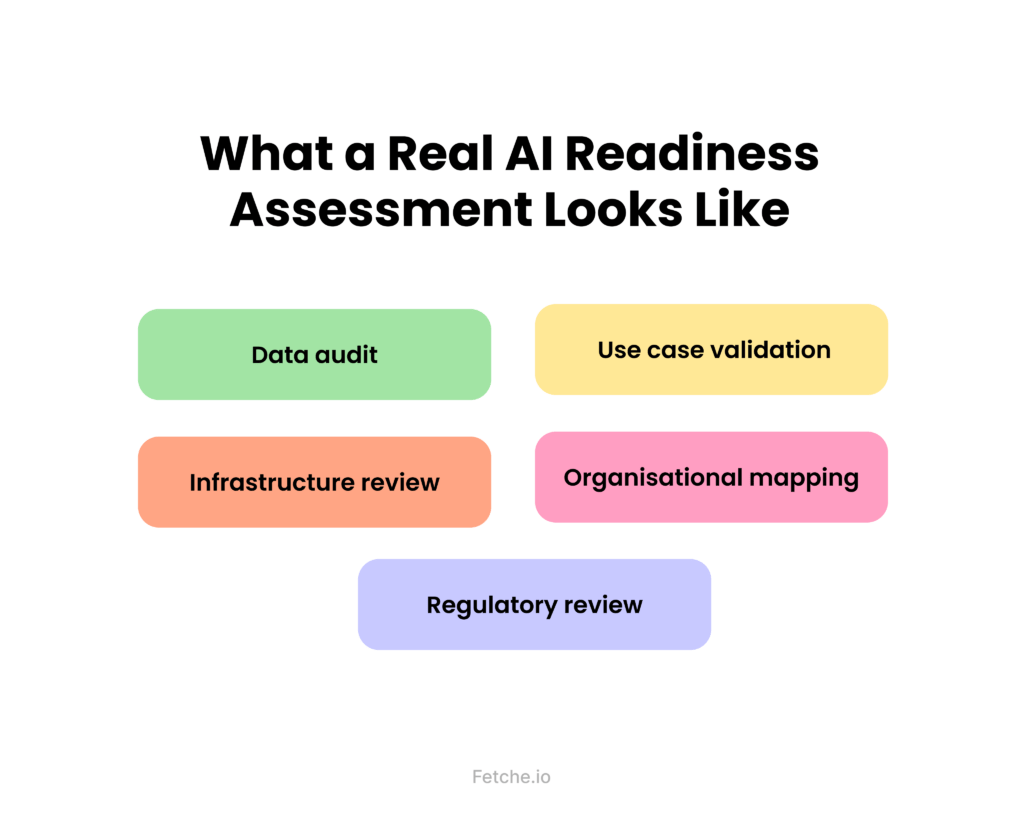
The output of good AI readiness assessment services is not a recommendation to proceed or not proceed with AI. It’s a clear picture of what investment is required before the AI build begins, and what realistic timelines and outcomes look like given where the organisation currently stands.
Note – Enterprises that skip this step and go straight to development almost always encounter the readiness problems mid-project, when fixing them costs significantly more than addressing them upfront would have.
Do You Really Need AI?
Not every business problem needs AI. A rule-based automation can solve a significant number of enterprise workflow problems at a fraction of the cost and complexity of a machine learning system. A good enterprise AI solutions partner in the UAE will tell you this. A vendor trying to close a deal won’t.
The C-suite should go into any AI engagement with a clear idea of what problems are genuinely AI problems and what problems are being dressed up as AI problems because AI is the current vocabulary for “we need to fix this.”
When to Delay Your AI Investment
This is the part most AI vendors won’t tell you. Sometimes the right answer is: not yet. Not never. Not that we’re too small or too traditional or too cautious. Not yet, because there’s foundational work to do first that will make the investment significantly more likely to succeed.
Consider delaying if:
- Your data isn’t ready, and there’s no plan to fix it
AI built on bad data produces bad outputs. Not obviously bad outputs that are easy to catch, but subtly wrong outputs that erode trust gradually and are expensive to diagnose.
- The problem isn’t specific enough
“Use AI to improve operations” is not a problem statement. It’s a direction. Spending significant budget on a direction produces a system that technically functions but delivers no measurable outcome.
- There’s no internal owner
An AI system without a named internal owner (someone accountable for its performance, its outputs, and its ongoing development) degrades. Models drift. Edge cases accumulate. Nobody notices until the system is quietly broken.
- Leadership alignment is surface-level
If the CEO is enthusiastic but the COO hasn’t been brought in, or the CISO has concerns that haven’t been resolved, the project will encounter those fractures during implementation when they’re much harder to fix.
Delaying is not failure. Getting these conditions in place first and then investing is how enterprise AI solutions in the UAE actually succeed.
Choosing the Right AI Partner for the UAE Market
When the readiness work is done and the investment decision is made, the choice of development partner matters enormously. The UAE market has expanded fast. Quality ranges widely. Here’s what actually separates a capable AI solutions company in the UAE from a mediocre one.
- They ask about your data before they talk about your model
This is the clearest early signal of technical maturity. The data conversation should happen before any technology is proposed.
- They tell you when AI is the wrong answer
The best AI development partners in Dubai will tell you when a simpler solution solves your problem better. That honesty costs them the deal in the short term. It’s also the reason their clients come back.
- They have real UAE deployment experience
Arabic NLP, data residency architecture, and regulatory familiarity don’t transfer automatically from experience in other markets. Ask specifically about UAE deployments. Ask what went differently here.
- They talk about what happened after launch
Case studies that end at go-live are incomplete. Ask what the system looks like six months later. Is it still performing? Has it been retrained? What did they learn post-deployment?
- They have a view on governance
Responsible AI is the direction of regulatory travel in the UAE. A development partner worth working with has a clear position on how the systems they build are monitored, audited, and governed over time.
Final Thoughts
The UAE is moving faster on AI than almost any comparable market. The policy environment, the infrastructure investment, and the concentration of digitally mature enterprises in sectors like fintech, logistics, and real estate mean that AI adoption here is not a distant future state. It’s a present competitive reality.
But speed without readiness produces waste. And the UAE market has seen enough expensive, underutilised AI projects to know that enthusiasm at the C-suite level does not automatically translate into operational value. The enterprises that will come out ahead are the ones that do the readiness work first. That get specific about the problem before selecting the technology. That treat data as the foundation, not an afterthought. That build governance in from the start because the regulatory environment is only going to get more demanding, not less.
AI business transformation isn’t a project with a finish line. It’s a capability your organisation builds over time. The C-suite leaders who understand that, who approach their first AI investment as the first step in a longer capability-building journey, make better decisions, build better systems, and get better outcomes.
At WEFT Technologies, we work with founders and enterprise leaders across the UAE who are serious about building AI capability that delivers measurable value. That starts with an honest readiness assessment, not a pitch. We’ll tell you what’s in place, what isn’t, and what a realistic investment looks like to get to an outcome worth having.