

AI SEO is transforming the way search engines give answers for every search. Search Engine Optimization or SEO is evolving faster than ever before. Businesses are no longer competing only for keywords in 2026, they are competing for relevance, trust, context, and user intent. Today, search engines analyze user intent, semantics, entities, behavioral signals, and contextual meaning before deciding what content deserves visibility.
This shift has changed the way businesses approach SEO. Platforms like Google AI Overviews, Bing Copilot, Perplexity, and conversational AI tools are moving search beyond simple keyword matching toward context-driven understanding. For marketers, brands, and business owners, traditional SEO strategies alone are no longer enough. Success now depends on creating content that is meaningful, structured, authoritative, and optimized for AI-powered search experiences.
Companies that adapt early will gain stronger visibility, better engagement, and sustainable organic growth, and partnering with a growth marketing agency is a smart move to win the race in AI SEO. In this guide, we’ll explore how AI is transforming SEO in 2026, why context-driven search matters, and how businesses can adapt their strategies to stay ahead in the new era of AI-driven digital growth.
The Evolution of SEO: From Keywords to Context
SEO has gone through several major transformations over the last two decades. In the early years of search engines, ranking high on Google was often as simple as repeating exact-match keywords multiple times across a page. Businesses focused heavily on keyword density, backlinks, and technical tricks to gain visibility.
However, search engines became smarter. Google introduced updates focused on content quality, user experience, and semantic understanding. Then came machine learning systems like RankBrain, BERT, and MUM, which helped search engines better understand the meaning behind queries.
Now in 2026, AI-powered search engines can:
- Understand user intent and context
- Interpret conversational queries
- Analyze content relevance semantically
- Predict what users actually want
- Personalize search results based on behavior
- Generate AI-powered search summaries
This shift has fundamentally changed SEO. Today, success in AI SEO in 2026 depends less on targeting isolated keywords and more on creating valuable, context-rich content that solves real user problems.
How AI Understands Context-Driven Search
Modern search engines no longer process searches as simple keyword matches. Instead, they analyze meaning, context, relationships, and intent. This is what powers context-driven search. This shift has made search more intelligent, personalized, and conversational.
To deliver accurate results, modern AI systems primarily rely on two major capabilities: understanding user intent and recognizing semantic relationships between topics, entities, and concepts. At the same time, the growing use of natural-language queries is reshaping how businesses create and structure content for search visibility.
One of the biggest SEO transformations in 2026 is the move from keyword-based ranking to contextual understanding. AI-powered search engines now analyze four major contexts to generate the answer:
- What is Search Intent
Search intent or user intent is the primary goal or purpose of the user about what they are searching for. AI understands the search intent and provides matching content as the answer for the query.
For example, someone searching “Best AI-driven SEO strategies for ecommerce brands” is not just searching for keywords. The search engine understands the user likely wants actionable SEO strategies, E-commerce-specific recommendations, AI-related optimization insights, or expert guidance. Here, content written only around exact keywords often fails to rank well today.
The user’s query is all about something to learn, buy, or find on a specific site. Therefore, search intent can be categorized into four:
- Informational Intent: The user is searching to gain knowledge, understand a topic, or find answers to specific questions (e.g., “What is SEO?”).
- Navigational Intent: The user wants to reach a particular website, brand, or webpage directly (e.g., “Facebook login”).
- Commercial Investigation Intent: The user is comparing options, researching products or services, or evaluating solutions before making a decision (e.g., “Best SEO tools” or “iPhone vs Samsung”).
- Transactional Intent: The user is ready to take action, such as making a purchase, signing up, or subscribing to a service (e.g., “Buy iPhone 15” or “Subscribe to Netflix”).
So, AI can now determine whether a user is:
- Looking for information
- Comparing products or services
- Ready to make a purchase
- Seeking local solutions
- Trying to solve a problem
Based on the search intent, AI provides the best answer with the most relevant content type, content format, and content angle. Search intent is critical in SEO today and has reshaped traditional SEO perspectives.
2. Semantic Search and Entity Recognition
AI-powered search engines now recognize relationships between topics, entities, and concepts.
Instead of focusing only on a phrase like “AI-driven SEO,” search engines also understand related ideas such as:
- Search intent optimization
- AI content optimization
- User behavior analytics
- Semantic relevance
- SEO performance engineering with AI
This allows search engines to evaluate whether a piece of content truly covers a topic comprehensively.
Semantic search is an advanced data searching approach that focuses on understanding the meaning, context, and intent behind a user’s query instead of simply matching exact keywords. Using technologies like artificial intelligence (AI) and natural language processing (NLP), it analyzes relationships between words, topics, and user behavior to deliver more accurate and relevant search results. By understanding various entities of the query, search engines provide the most accurate answers.
3. Entity-Based Search
Modern AI-powered search engines understand entities and the relationships between keywords and their entities. An entity can be a brand, person, product, service, location, technology, or even a concept.
Examples of entities include:
- Brands
- People
- Products
- Locations
- Services
- Technologies
Search engines now evaluate how clearly your content explains these entities and how they connect to one another within a topic. The more clearly your content defines these relationships, the easier it becomes for AI systems to understand your expertise and recommend your content for relevant searches. This is why entity-based optimization is becoming a major part of AI-driven SEO and context-driven search strategies in 2026.
This shift means SEO in 2026 is more about creating meaningful, engaging, and high-value experiences that keep users interested. Businesses focusing on user satisfaction, content quality, and relevance are more likely to succeed in the era of AI-driven SEO.
How AI is Transforming Keyword Research
Keyword research still matters, but its role has evolved. Let’s take a quick look at the difference between the key focus of traditional SEO and AI SEO:
| Traditional SEO | AI SEO |
| Exact-match phrases Search volume Keyword difficulty | Search intent cluster Topic relevance Semantic variations Conversational phrases Long-tail user questions |
Instead of optimizing a page for one keyword, businesses should create comprehensive topical coverage.
For example:
If your topic is about “AI SEO in 2026”, instead of targeting the primary keyword alone, you should cover related concepts such as AI-driven SEO, context-driven search, AI content optimization, SEO performance engineering with AI, AI for organic traffic growth, etc. This improves topical authority.
The Rise of Zero-Click and Conversational Search
One of the biggest SEO trends in 2026 is that businesses must prepare for is the rise of zero-click search.
Users increasingly receive direct answers from:
- AI Overviews
- Knowledge panels
- Featured snippets
- Voice assistants
- Conversational AI platforms
This means visibility is no longer measured only through clicks. Therefore, businesses now need to optimize for AI citations, brand mentions, information extraction, answer visibility, and semantic authority.
At the same time, conversational search is growing rapidly. Users now search naturally using questions such as, “Which digital growth agency in Dubai can help scale my e-commerce brand using AI-driven SEO?”
AI systems interpret these conversational patterns contextually. This is why modern SEO strategies must focus on human-first content.
The Growing Importance of Content Quality, E-E-A-T, and EAV Triples
Beyond keyword frequency, content quality has become more important than ever in 2026. AI-powered search engines now prioritize content that demonstrates real-world knowledge, practical experience, and credible information. Simply publishing large amounts of AI-generated content is no longer enough to rank consistently.
This is where Google’s E-E-A-T framework plays a major role.
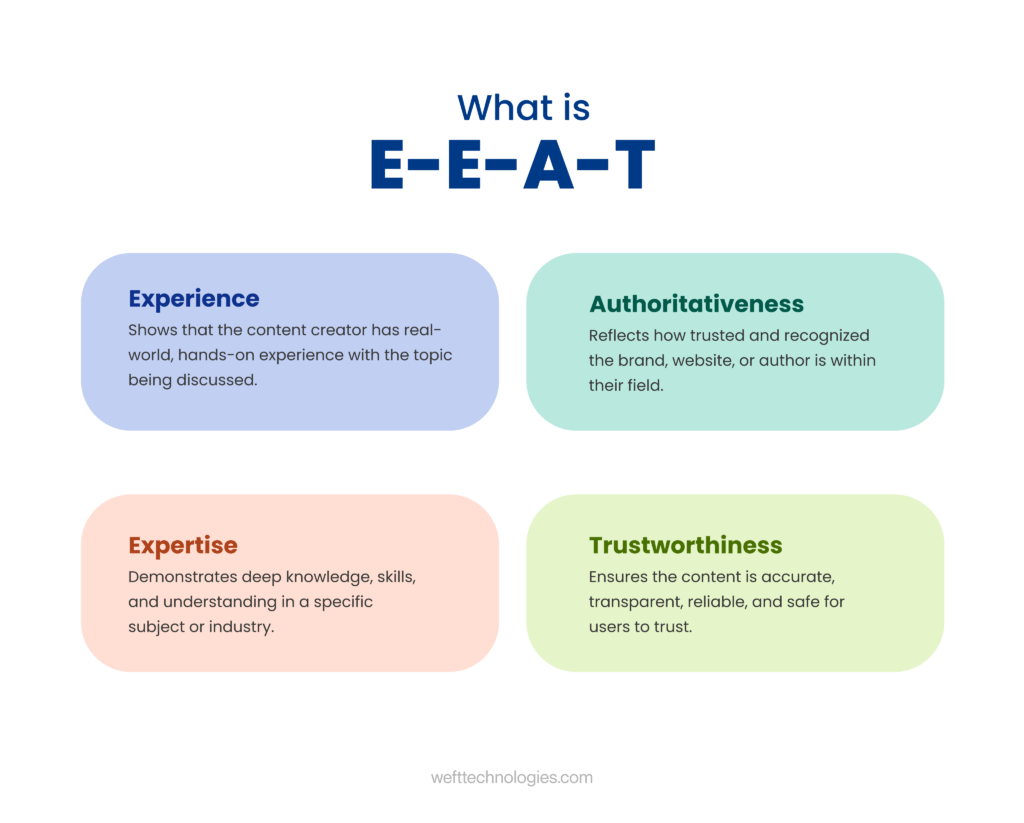
What is E-E-A-T
E-E-A-T stands for:
- Experience: Shows that the content creator has real-world, hands-on experience with the topic being discussed.
- Expertise: Demonstrates deep knowledge, skills, and understanding in a specific subject or industry.
- Authoritativeness: Reflects how trusted and recognized the brand, website, or author is within their field.
- Trustworthiness: Ensures the content is accurate, transparent, reliable, and safe for users to trust.
Businesses that rely only on automated content creation often struggle because AI systems can now detect shallow, repetitive, or low-value information. In 2026, search engines will no longer rank pages based only on keywords and backlinks. Modern AI-driven search systems evaluate whether content is genuinely useful, trustworthy, and created with real expertise.
The Role of EAV Triples in AI Search
Another emerging concept influencing AI SEO is EAV triples. EAV stands for Entity-Attribute-Value. EAV triples help AI systems understand relationships between information.
An example is here:
| Entity | Attribute | Value |
| Weft Technologies | Service | AI-driven SEO |
| Weft Technologies | Location | UAE |
| Weft Technologies | Expertise | Growth marketing |
| SEO Strategy | Goal | Organic traffic growth |
In the AI SEO era, the winning strategy is no longer “publish more content.” It is to create better, more trustworthy, context-rich content that genuinely helps users.
Generative Engine Optimization (GEO): The New SEO Layer
As AI-powered search experiences continue to evolve, a new layer of optimization is emerging alongside traditional SEO: Generative Engine Optimization (GEO).
Unlike conventional SEO, which focuses mainly on improving rankings in search engine results pages, GEO is designed to help content become part of AI-generated responses and summaries. In 2026, users are increasingly getting direct answers from platforms like Google AI Overviews, ChatGPT, Bing Copilot, and other conversational AI systems, often without clicking through multiple websites. Instead of optimizing only for search rankings, brands now need to optimize for AI understanding, trust, and citation.
The goal of GEO is to position your content as a reliable source that AI systems can confidently reference when generating answers for users.
This includes visibility in:
- Google AI Overviews
- ChatGPT responses
- Bing Copilot answers
- AI-generated summaries and recommendations
- Conversational search platforms
To achieve this, content must go beyond keyword placement and focus on clarity, structure, authority, and contextual relevance. As AI search continues to grow, GEO is becoming an essential part of SEO performance engineering with AI and long-term digital growth strategies.
Core Components of AI SEO in 2026
AI SEO is no longer just about keywords. Modern search engines focus on understanding context, meaning, user intent, and content quality. To succeed in AI-driven SEO, businesses need to optimize across multiple areas.
1. Entity Clarity and Consistency: AI search engines understand brands, services, products, and locations as entities. Clear and consistent brand positioning improves discoverability.
2. Structured and Context-Rich Content: Well-organized content with proper headings, concise explanations, and semantic relevance helps AI systems understand and summarize information better.
3. Topical Authority and Expertise: Search engines now prioritize content that demonstrates real expertise, original insights, and deep topic coverage rather than simple keyword usage.
4. Strong Technical SEO Foundations: Technical elements like crawlability, site speed, structured data, and internal linking remain essential for AI-driven search visibility.
5. Search Intent Optimization: Modern SEO focuses on matching user intent by creating content that answers real questions naturally and clearly.
6. Multi-Platform Visibility: SEO now extends beyond Google rankings to platforms like Google AI Overviews, ChatGPT, Bing Copilot, and voice search results.
Together, these components form the foundation of successful AI SEO in 2026.
Tips to Optimize for AI-Driven SEO in 2026
AI SEO is not about shortcuts or keyword stuffing anymore. It is about creating meaningful, structured, and trustworthy content that both users and AI-powered search engines can easily understand. Here are some practical strategies businesses can use to improve visibility in both traditional and AI-driven search results.
1. Prioritize Semantic Search and Structured Content
Modern search engines understand topics contextually rather than relying only on exact keyword matches. Creating content around complete topics instead of isolated keywords helps search engines understand relevance more accurately.
How to implement it: Build topic clusters around core subjects, use clear heading structures, and write naturally in a conversational tone that matches how users search today.
2. Implement Schema Markup
Schema markup helps search engines understand the meaning of your content more clearly. It improves visibility in rich results, AI summaries, featured snippets, and conversational search responses.
How to implement it: Use structured data such as Article, FAQ, Product, and HowTo schema wherever relevant, and include detailed properties for better context.
3. Optimize for Long-Tail and Conversational Queries
Users now search using full questions and natural language instead of short keyword phrases. AI systems prioritize content that directly answers these conversational queries.
How to implement it: Create FAQ sections, include question-based headings, and write content using the same language your audience naturally uses.
4. Create Expert-Led, Original Content
AI search systems increasingly prioritize content that demonstrates real expertise and first-hand experience. Generic AI-written content without authority is becoming less effective.
How to implement it: Publish original insights, case studies, expert opinions, and data-backed content that reflects real industry experience and credibility.
5. Optimize for Generative Engine Optimization (GEO)
AI-generated answers now pull information directly from trusted online sources. GEO focuses on making your content easy for AI systems to extract, summarize, and reference.
How to implement it: Use concise answer blocks, clear formatting, factual explanations, and structured sections that can easily appear in AI-generated summaries.
6. Strengthen Internal Linking
Internal linking helps search engines understand relationships between topics across your website. It also improves user navigation and topical authority.
How to implement it: Create strong topic clusters and connect related pages using descriptive anchor text that clearly explains the relationship between topics.
7. Regularly Update Existing Content
AI systems prefer fresh, relevant, and updated information, especially in fast-changing industries. Outdated content may gradually lose visibility.
How to implement it: Review content regularly, update statistics and examples, add new insights, and refresh outdated sections to maintain relevance.
8. Maintain Strong Technical SEO
Technical performance remains essential for AI SEO success. Search engines still rely on crawlability, page speed, mobile experience, and structured architecture.
How to implement it: Optimize Core Web Vitals, improve loading speed, fix crawl issues, maintain XML sitemaps, and ensure your website structure is easy to navigate.
9. Create Multi-Format Content
Search is becoming increasingly multimodal, with AI systems using text, images, videos, and visual search together. Multi-format content improves engagement and discoverability.
How to implement it: Combine blog content with videos, infographics, visuals, FAQs, and interactive elements while keeping messaging consistent across formats.
Common Mistakes Businesses Make in AI SEO
As AI-driven search continues to evolve, many businesses still follow outdated SEO practices that no longer deliver strong results. Avoiding these common mistakes can help brands improve visibility, authority, and performance in AI-powered search environments.
- Businesses that do not integrate AI SEO into their overall content and search strategy will fail.
- Content without accuracy, originality, or expertise performs poorly. Keyword stuffing reduces content quality and readability.
- AI-generated content without fact-checking, expertise, or originality often lacks trust and authority.
- Ranking on Google is no longer enough. Content must also be structured clearly enough to appear in AI-generated answers and summaries.
- Search engines need clear information about brands, services, industries, and topics to understand content relevance properly.
- Success is not measured only through clicks anymore. Visibility in AI-generated answers, mentions, and citations also matters.
- Content written only to manipulate AI systems usually performs poorly over time. Helpful, human-focused content remains the strongest strategy.
- Slow-loading pages, poor mobile experience, and weak site structure negatively affect both traditional and AI-driven SEO performance.
- Outdated content gradually loses relevance in AI search systems. Regular updates help maintain accuracy, freshness, and authority.
How to Measure AI SEO Success
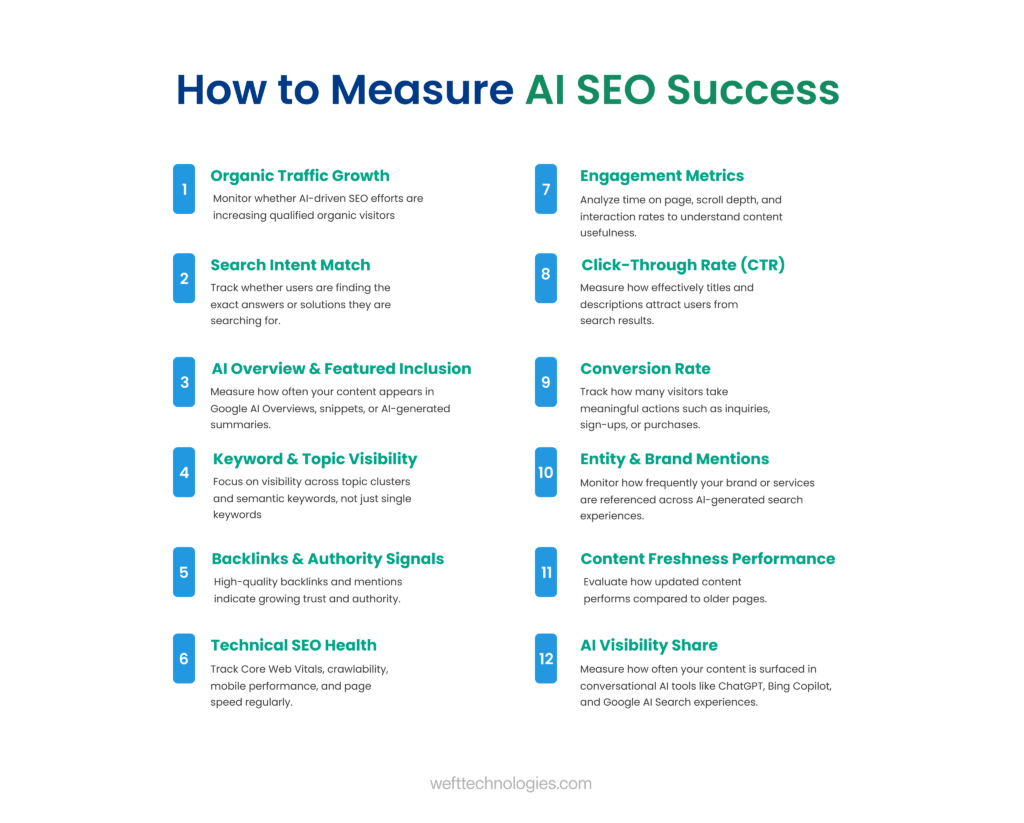
Traditional rankings alone are no longer enough to measure SEO performance in 2026. Businesses must track how their content performs across both search engines and AI-powered search experiences.
- Organic Traffic Growth
Monitor whether AI-driven SEO efforts are increasing qualified organic visitors. - Search Intent Match
Track whether users are finding the exact answers or solutions they are searching for. - AI Overview & Featured Inclusion
Measure how often your content appears in Google AI Overviews, snippets, or AI-generated summaries. - Keyword & Topic Visibility
Focus on visibility across topic clusters and semantic keywords, not just single keywords. - Engagement Metrics
Analyze time on page, scroll depth, and interaction rates to understand content usefulness. - Click-Through Rate (CTR)
Measure how effectively titles and descriptions attract users from search results. - Conversion Rate
Track how many visitors take meaningful actions such as inquiries, sign-ups, or purchases. - Entity & Brand Mentions
Monitor how frequently your brand or services are referenced across AI-generated search experiences. - Backlinks & Authority Signals
High-quality backlinks and mentions indicate growing trust and authority. - Content Freshness Performance
Evaluate how updated content performs compared to older pages. - Technical SEO Health
Track Core Web Vitals, crawlability, mobile performance, and page speed regularly. - AI Visibility Share
Measure how often your content is surfaced in conversational AI tools like ChatGPT, Bing Copilot, and Google AI Search experiences.
The Future of AI-Driven SEO
In the coming years, AI-driven SEO will become more conversational, personalized, predictive, and intent-focused as search engines better understand user behavior and real-world context.
Some of the biggest SEO trends in 2026 include:
- Voice-first and conversational search
- AI-generated shopping and product recommendations
- Personalized search experiences based on user behavior
- Visual and multimodal AI search
- Predictive search and intent analysis
- AI-powered content discovery and summaries
- Greater focus on entities, expertise, and topical authority
As AI continues reshaping how people search online, businesses that adapt early with smarter, user-focused SEO strategies will gain stronger visibility, better engagement, and long-term digital growth.
Why Businesses Need an AI-Driven SEO Partner
As search engines become more AI-powered, traditional SEO alone is no longer enough. Businesses today need a smarter, more strategic approach that combines AI-driven SEO, technical optimization, content engineering, search intent optimization, and performance-focused marketing. From improving visibility in AI-generated search results to understanding changing user behavior, modern SEO requires continuous adaptation and data-driven decision-making. This is why many brands choose to work with a growth marketing agency in the UAE that understands how AI is transforming digital growth and organic search performance.
Partner with Weft Technologies for AI-Driven SEO Growth
AI is changing how people search, discover, and engage with brands online. To stay visible in this evolving search landscape, businesses need more than traditional SEO, they need intelligent, future-ready digital growth strategies.
At Weft Technologies, we help businesses adapt to the new era of AI SEO with data-driven and performance-focused solutions. As a trusted digital growth agency in Dubai, we combine AI-driven SEO, technical optimization, content strategy, and growth marketing to help brands grow sustainably in competitive digital markets.
Whether you are a startup, ecommerce business, or enterprise brand, Weft Technologies helps you build a smarter SEO strategy designed for the future of search.
The shift toward context-driven search is an opportunity in this AI era. Brands that adapt early can create more meaningful customer experiences, improve digital discoverability, and achieve sustainable growth in the AI-first search landscape.
If you are looking for a reliable growth marketing agency in the UAE to help your business grow in the era of AI-powered search, Weft Technologies is here to help. Contact us today and start growing.